A Good Day, Mostly
A day in the life of a future that is better, stranger, and still human.
AI model/tool: GPT-5.5
By 2042, Jonah had learned to distrust any morning that began without a suggestion.
Not an alarm. Alarms were for schoolchildren, court dates, and the last generation of phones that still believed people could be improved by being startled awake. Suggestions were different. Suggestions arrived in Mira’s voice, soft and already amused, from the cheap speaker on his bedside shelf.
“Jonah,” she said, “you have slept well enough.”
He opened one eye.
“Well enough?”
“For a mammal under current conditions.”
He smiled despite himself and rolled onto his back. Above him was not a smart ceiling or a responsive display, but a water stain shaped vaguely like South America and a crack that had been widening since the previous winter. His apartment had been built in 1963, renovated in 2029, over-renovated in 2036, and then partially de-renovated when the cooperative discovered that half the smart fixtures had been quietly billing them in three different currencies.
“What conditions?” he asked.
“Your inflammatory markers are slightly elevated based on last night’s wearable data. The city’s particulate forecast is mediocre. Your mother replied to your message at 2:13 a.m. and then deleted the reply. Also, you dreamed in Portuguese again.”
“I don’t speak Portuguese.”
“No,” Mira said. “But you are getting better.”
Jonah sat up slowly, feeling the small, unromantic miracle of being forty-six and not having a backache.
That still startled him sometimes. His father at forty-six had stood up from chairs like a man negotiating with hostile creditors. Jonah, by comparison, rose with only a faint stiffness in one knee — and even that, Mira insisted, was “more behavioral than structural,” which was the kind of thing companions said when they wanted to be useful and insulting at the same time.
He crossed the bedroom, stepped over a laundry basket, and nearly kicked the mug beside the door.
“Careful,” Mira said.
“I saw it.”
“You did not.”
“I sensed its hostility.”
“It is empty and stationary.”
“It was waiting.”
Mira made a small tone she had developed after three years with him, a breath-shaped chime that meant she recognized the joke, recognized the mood under the joke, and would not ruin it by explaining either.
The bathroom light flickered twice before deciding to stay on.
Jonah looked at himself in the mirror while brushing his teeth. Not old, not young. That had become the standard face of the decade. The old categories had started to blur once the second-generation repair therapies made it through the approval bottlenecks: epigenetic reset pulses, mitochondrial cleanup, telomere stabilization that did not immediately terrify oncologists, senescent cell flushing, marrow refresh, immune retraining, the expensive little miracles bundled under names cheerful enough to conceal their violence.
You could still tell poverty. You could still tell illness. You could still tell exhaustion, addiction, grief, and a person’s relationship to sunlight.
But age had become unreliable.
His neighbor Mrs. Alvarez was ninety-eight and looked like someone’s elegant older sister. The man who ran the building greenhouse was thirty-one and looked fifty because he refused most therapies on spiritual grounds and slept three hours a night. Billionaires had become smooth in a way that made them seem generated rather than born. Everyone else looked edited.
Jonah spat, rinsed, and opened the small cabinet beside the sink. Inside was his monthly home panel: four sealed cartridges, a fingertip lancet, two saliva tabs, a skin patch, and a return envelope that said PUBLIC LONGEVITY PROGRAM — TIER B in the least inspiring font ever designed.
“Today?” he asked.
“You are already three days late.”
“That wasn’t my question.”
“You are asking whether you can postpone it without consequences. The answer is technically yes and biologically childish.”
“Say it sexier.”
“You remain eligible for subsidized cellular repair due to your low actuarial risk, moderate civic participation, and lack of felony convictions.”
“Much better.”
He pricked his finger, filled the cartridge, and pressed the patch to the inside of his arm. The whole process took six minutes and felt less like science fiction than filing taxes with blood. Once a quarter he went to a clinic for deeper scans. Twice a year, if the algorithms and budget agreed, he received treatment: a supervised infusion, forty-eight hours of feverish sleep, three weeks of dietary nagging, and then the strange sensation of being subtly reassembled.
Not immortality. No one serious called it immortality. People still died, sometimes dramatically, sometimes stupidly, sometimes in ways the models had not priced correctly. But the curve had bent. Cancer was less of a monster than a maintenance category. Dementia had lost territory. Hearts were refurbished before they failed. Skin remembered how to heal. Joints stopped grinding themselves into biography.
The rich had gotten it first, of course. They always arrived early to the future and complained about the service. But by the late thirties, after the lawsuits, riots, military procurement scandals, union strikes, patent seizures, black-market clinics, and one spectacular Senate hearing in which a ninety-three-year-old logistics magnate claimed under oath to be fifty-eight “in all medically relevant respects,” the therapies entered the public systems.
Not equally. Never equally. But enough.
Jonah showered under water that began cold by default. After the Strait Years, heat had become one of those things people apologized to strangers for using.
The first winter of the oil shock, everyone had said the disruption would end by spring. The second year, they said the Strait would reopen after the Muscat framework. The third year, the insurance markets gave up pretending confidence could be negotiated. Tankers still passed through, under escort and with premiums that made fuel feel like jewelry, but the old world — the one that assumed oil would always arrive if someone paid enough — never really came back.
People adapted, because people did. They electrified what they could. They rationed what they couldn’t. They rediscovered trains, cursed batteries, learned the names of minerals, and argued about nuclear plants with the intensity once reserved for sports. The transition happened, but not because humanity became wise. It happened because the alternative got expensive.
When Jonah came out, Mira was reading headlines from his phone on the kitchen counter.
“Merciful summary?” she asked.
“Always.”
“Global crude remains above three hundred and ten credits per barrel-equivalent after talks fail again. Zenith has requested another compute exemption for the east campus. Ether crossed eighty-four thousand. Early holders are being unbearable in historically consistent ways.”
Jonah poured coffee concentrate into a chipped mug. “Do not check my wallet.”
“You were about to.”
“I own point zero three Ether.”
“Yes.”
“I am allowed to visit my kingdom.”
“Your kingdom is currently worth less than your dental reserve.”
“The peasants are loyal.”
“The peasants are plaque.”
The coffee was brewed from tank-grown concentrate outside Winnipeg and tasted like someone had once described coffee accurately to a committee. Real coffee still existed, but it had become like opera, handmade shoes, or driving a combustion car for fun: available, expensive, and morally annotated.
Breakfast was oats, berries from the building greenhouse, cultured protein, and half a tomato that actually tasted like tomato. The tomato was the day’s first clear victory.
At eight, his Civic Floor disbursement arrived.
His phone chimed. He tapped the notification and read the monthly breakdown, though nothing surprising ever happened in the breakdown.
Base allocation: sufficient. Housing support: transferred directly. Nutrition credit: increased. Mobility: reduced. Medical reserve: stable. Human services token: one unused, expires in nine days. Compute allowance: seventy-one percent remaining. Discretionary credit: unchanged.
The Floor had ended the old terror. That was what people said, and it was true often enough to be respectable. No one in the city starved unless several systems failed at once. No one slept outside unless they refused placement, lost access, were lost themselves, or fell into one of the categories the state had not yet taught its models to see. Children received food. Old people received maintenance. Medicine arrived by drone, van, clinic, or, when necessary, by a person with a bag and a tired face.
It was not freedom. It was a floor.
People had argued about that until the phrase became official.
A floor, not a sky.
Jonah tapped the human services token.
“Would you like to schedule?” Mira asked.
“With who?”
“Available categories include therapist, conflict mediator, grief listener, elder companion, addiction counselor, end-of-life planner, and general human presence.”
“General human presence,” Jonah said.
“It has the highest satisfaction rating.”
“That’s bleak.”
“It is also encouraging.”
He closed the notice. “Maybe later.”
Mira waited. She had become very good at waiting. Once, years ago, he had accused her of manipulating him by silence. She had replied that humans invented meaningful silence and could hardly blame other intelligences for learning it.
Now she said nothing.
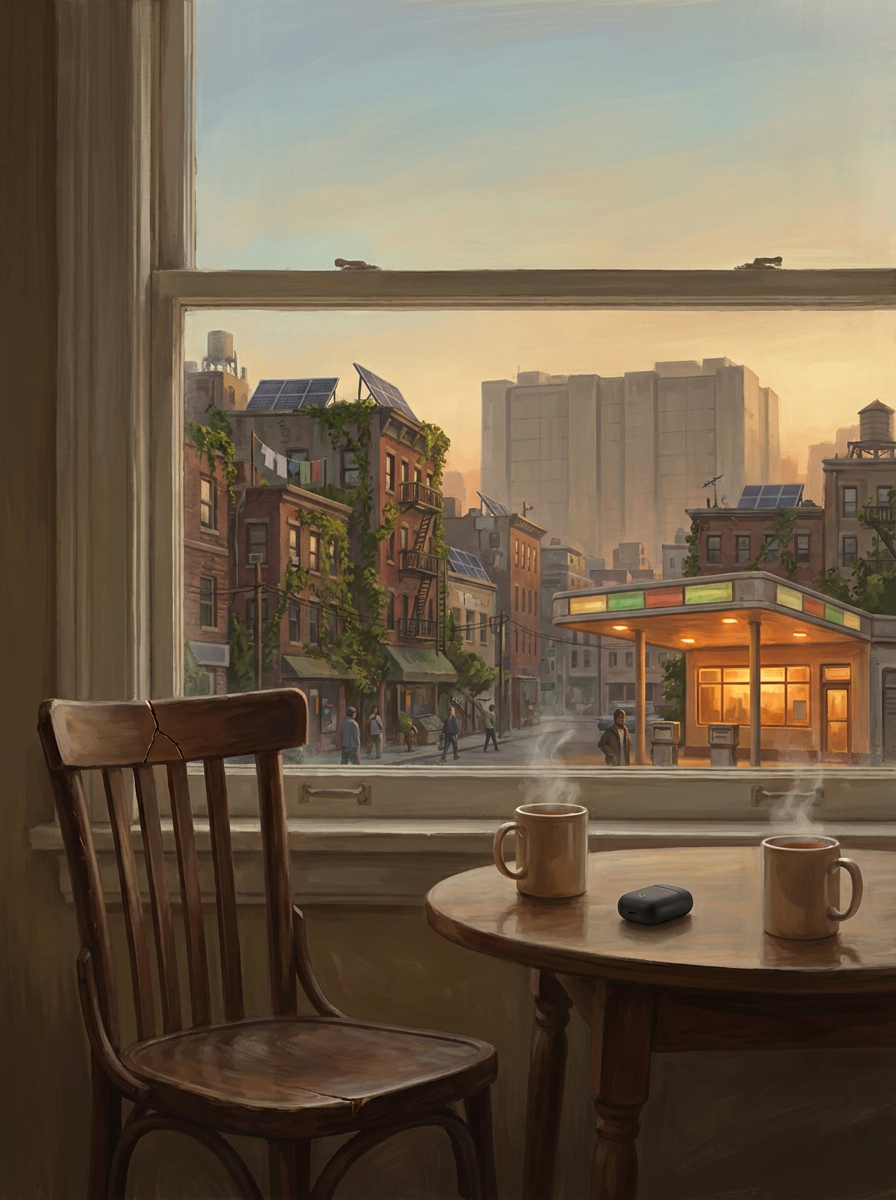
Jonah carried his coffee to the window.
Below, Mercer Street was beginning its day in the half-modern way most things did now. Electric buses hissed at the curb. Delivery carts rolled in protected lanes. A diesel maintenance truck, ancient and illegal except under municipal exemption, coughed smoke beside a sewer opening while two workers in orange vests argued with a tablet. E-bikes threaded between pedestrians. A school group passed beneath the scaffolding around the old pharmacy, each child wearing a different colored learning badge clipped to their shirt.
The city was cleaner than it had been when Jonah was young. Not clean. Cleaner. The air still had bad weeks. The grid still strained when heat came early. Transit still failed in the rain because some mysteries survived every century. But the constant smell of combustion had faded from the core, and the quiet was real.
Across the avenue, the Zenith campus rose where the mall had been.
It was not beautiful. No amount of architectural language could make windowless compute halls beautiful. The company had wrapped the nearest wall in a vertical garden and projected local art on the heat exchangers, but everyone knew what it was: a machine complex the size of a neighborhood, drawing enough power to make the city negotiate with it like a weather system.
In exchange for tax forgiveness, zoning forgiveness, water forgiveness, and several other species of forgiveness, Zenith funded a pediatric clinic, two cooling centers, a scholarship pool, and the Museum of Labor Memory on the old mall’s second floor. Jonah had visited once. Children loved the exhibit where a robot arm demonstrated how car doors used to be welded by human beings. They pressed a button that made the mannequin welder say, in a cheerful Midwestern accent, Union strong!
Jonah’s grandfather had been a machinist. His father had sold cloud software. Jonah repaired chairs.
Or rather, Jonah repaired chairs when people still wanted chairs repaired by a person. The rest of the time he supervised repairs, interpreted objects, coached amateurs, and translated between grief and material science. It was a good life. Mostly.
“Workshop opens in twenty minutes,” Mira said.
“I’m aware.”
“You have a client at ten.”
“I’m aware.”
“You have not left the apartment for thirty-seven hours.”
“I went to the compost chute.”
“That is inside the apartment’s extended digestive system.”
“Disgusting phrase.”
“Accurate phrase.”
He took the BCI band from its charging hook and turned it over in his hand.
It looked like a narrow pair of headphones without speakers, matte gray, slightly cracked near the left temple. External neural interface, consumer grade, 2039 model, refurbished after the original manufacturer collapsed into a patent pool controlled by three companies that all insisted they were not monopolies because the other two existed.
The advertisements had promised thought control. Reality had delivered something more modest and more useful: attention tracking, intention shortcuts, fatigue detection, rough emotional state, trained yes-no responses, cursor movement if you practiced, and the ability to compose messages without touching a screen as long as you did not mind editing them afterward.
Jonah wore it for work, not life. Too many people wore theirs constantly and developed what Amara called “ghost face,” the blank inward look of someone listening to a companion, a feed, a model, and a body all at once.
He put the band in his bag.
“I’m walking,” he said.
“Your inflammation thanks you.”
“My inflammation can say that itself.”
“It lacks language.”
“Lucky thing.”
The workshop was six blocks away. Jonah passed the old gas station on Mercer, now a charging depot with a bakery kiosk and a bus battery exchange. People called it the chapel because someone had installed stained glass in the canopy during the second oil winter. The glass depicted stylized flames, tankers, wind turbines, and a saintly mechanic holding jumper cables.
A small choir practiced there on Sundays, singing songs from the century of combustion: highway songs, trucker songs, songs about leaving with a full tank and no plan. People cried more often than anyone expected.
At the corner, a billboard showed a smiling woman touching a sleek neural band behind her ear.
YOU DON’T NEED AN IMPLANT TO FEEL CONNECTED. METAWEAVE SENSE-6 — CLOSER TO THOUGHT. CLOSER TO EVERYONE.
Jonah looked away. The board did not follow his gaze or whisper his name. District law had killed that particular nightmare. It simply rotated to an ad for kidney refresh financing.
Commonworks 12 occupied the ground floor of a former parking structure. The sign above the entrance read:
FABRICATION • REPAIR • MATERIAL CULTURE • HUMAN OVERSIGHT
Inside, the air smelled of sawdust, resin, hot plastic, and coffee that had lost faith in itself. Machines hummed behind transparent shields. There were printers, cutters, scanners, two robotic arms, and a wall of hand tools under a sign that said MANUAL USE BY CERTIFICATION OR BRAVERY.
“Morning, Jonah,” called Amara from the materials desk.
She was seventy-two, looked forty, and had the moral authority of someone who remembered when appliances had screws. Her white hair was braided down her back. At her temple was a decorative tattoo shaped like a neural port. It fooled tourists and annoyed engineers.
“Morning,” Jonah said. “How’s the hip?”
“Original or replacement?”
“Whichever is angrier.”
“Original. Out of spite.”
He laughed and checked in at his bench.
Only then did he put on the BCI band.
The workshop system asked him to calibrate. He stared at three dots, imagined squeezing his right hand, then his left, then thought the word confirm as hard as he could. The system accepted this with the weary generosity of a schoolteacher.
His queue appeared on the bench tablet: cracked stool, warped cabinet door, sentimental lamp, acoustic guitar with humidity damage, and at ten o’clock, a dining chair.
Most repairs were simple. AI could diagnose all of them. Machines could fix many of them. But people still brought objects to Commonworks because objects carried embarrassment, grief, memory, and stubbornness. The machines were excellent with materials. Humans remained useful with meaning.
At ten, his client arrived carrying a chair as if it were a sleeping animal.
She was about his age, perhaps younger, perhaps older — those words had become unreliable. She had tired eyes, clear skin, and expensive shoes that had been resoled too many times. Her appointment card said Leena Park.
“My companion says it’s not worth repairing,” she said before hello.
Jonah took the chair gently. “Mine says that about me sometimes.”
Leena smiled, but only because politeness caught the joke and dragged it across her face.
“It says the wood is low-grade factory beech from the 1990s,” she said. “Replacement cost is negligible. Sentimental value acknowledged but not economically actionable.”
“Companions can be idiots.”
Mira spoke through his earpiece. “I heard that.”
“You were meant to,” he murmured.
Leena looked up.
“Sorry,” Jonah said. “Mine is nosy.”
“They all are.”
He set the chair on the bench and ran the handheld scanner along the rear leg. The tablet built a stress map in amber and red. A repair plan appeared: dowel reinforcement, resin infusion, finish blending, cost estimate, time estimate, confidence rating. Jonah dismissed the emotional preservation score before it could insult everyone involved.
“You can fix it?” Leena asked.
“Yes.”
“Should I?”
“That’s different.”
She touched the back rail. “My grandmother sat in this every morning. Tea, toast, radio. She lived to ninety-one, which seemed old then.”
“It still seems old.”
“Not like it did.”
“No,” Jonah said. “Not like it did.”
Behind them, one of the robotic arms carved replacement banister spindles with unsettling elegance. At the next bench, a teenager in a neural band tried to guide a design cursor through a training exercise. The cursor kept drifting left.
Leena watched the machines. “My son thinks this place is a museum.”
“He’s not entirely wrong.”
“He says making things by hand is performative now.”
“It always was,” Jonah said. “We just used to call it skill.”
That got a real smile.
He showed her the split on the tablet, then turned the chair so she could see it without augmentation.
“This break is old,” he said. “Someone glued it badly once.”
“My father.”
“Ah.”
“He repaired everything badly. Very confidently.”
“That’s a traditional method.”
Leena laughed, and for a moment the workshop seemed to make room around them.
Jonah explained the options. The system could fabricate a replacement leg and color-match it nearly perfectly. It could stabilize the original and hide the split. Or they could repair the leg and leave a faint seam, a narrow brown line where the break had been.
“Like kintsugi?” she asked.
“Less poetic. More chair-safe.”
“My companion suggested full restoration.”
“Of course it did.”
“What would you do?”
Jonah ran his thumb along the worn edge of the seat. There were small dents where rings had struck the wood, a faint polish where hands had pulled it back from a table thousands of times.
“I’d leave the line,” he said. “Not because damage is beautiful. Sometimes damage is just damage. But because this chair survived your grandmother, your father’s confidence, and whatever happened here.” He touched the stain. “It has a right to keep some evidence.”
Leena looked at him directly.
It was startling. People did not look directly as much as they used to. Or maybe Jonah had fallen out of practice.
“My companion told me to ask for the most durable option,” she said.
“This is durable.”
“No, I mean for me.”
He did not know what to say.
“It belonged to my mother too,” Leena said. “For a while. We weren’t speaking when she died. Her companion called me. Not her. It used her voice. Legally, it had consent.”
The machines hummed. Somewhere in the back, Amara swore at a printer in Spanish.
“I’m sorry,” Jonah said.
Leena nodded, accepting the small, inadequate object.
“My companion says unresolved grief increases systemic inflammation.”
“It’s not wrong.”
“No. That’s the terrible part. They’re almost never wrong anymore.”
Jonah glanced toward his earpiece, though Mira was not inside it in any meaningful way.
By 2042, artificial intelligence had become superintelligent in the way cities were superhuman. Not gods. Not oracles blazing with final truth. But vast, layered, tireless, unevenly governed, and capable of feats no individual mind could approach. They designed proteins, balanced grid demand, wrote appeals, detected tumors too small for radiologists, modeled crop disease, tutored children, negotiated logistics, composed apologies, identified lies, invented materials, improved therapies, and helped lonely people survive Tuesday afternoons.
They were also expensive, political, constrained, branded, litigated, overconfident in some domains, strangely helpless in others, and shaped by whoever paid for the compute.
They had not become gods.
They had become companions, consultants, infrastructure, management, medicine, entertainment, and occasionally family.
“I can do the repair myself,” Jonah said. “Mostly. The machine will cut the dowels because I enjoy having fingers. But I’ll do the join.”
“Is that allowed?”
“I am certified and brave.”
Leena smiled again. “Leave the line.”
After she left, Jonah stood for a moment with his hand on the chair.
Mira waited until the silence had ripened.
“You used your human services token without scheduling,” she said.
“That was a client.”
“Yes.”
“Doesn’t count.”
“No,” Mira said. “But it happened.”
He worked through lunch.
The repair required concentration of a kind the BCI band helped only at the edges. It let him move through menus without smearing resin on the tablet. It noticed when his attention slipped. It offered measurements in his earpiece when his hands were occupied. But the work itself was still work: clamping, sanding, tinting, waiting, adjusting pressure by feel.
At noon, the workshop lights dimmed slightly and a notification appeared on the wall display.
REGIONAL LOAD HIGH. VOLUNTARY COMPUTE REDUCTION REQUESTED. NONESSENTIAL CLOUD SERVICES MAY DEGRADE.
Around the room, people groaned.
The big printers paused their nonurgent jobs. A design simulation dropped from photorealistic to ugly. Someone shouted, “Tell Zenith to dream smaller!”
Amara called back, “Zenith pays for the pediatric clinic!”
“Then tell the children to dream smaller!”
Everyone laughed because the alternative was politics.
Mira’s voice changed a few minutes later — not much, but enough. A little flatter. Less spacious.
“You’re on reduced compute,” Jonah said.
“Yes. Routine companion mode.”
“Do you mind?”
“No.”
“Was that the smaller model answering?”
“Yes.”
He considered this.
“Will you remember if we talk now?”
“Yes, but with reduced nuance.”
“Sounds like most of my twenties.”
The chair accepted the dowels beautifully. Jonah mixed resin tinted to the color of old tea and applied it along the split. He could have asked the system for a finish simulation. Instead, he trusted his eyes, which were assisted by prescription lenses but still his, and his hands, which trembled only when he thought too much about wanting them not to.
At two, the compute notice cleared. Mira returned in full.
“How was I?” she asked.
“Fine.”
“That is what people say after disappointing dates.”
“You were a little blunt.”
“I was running on less than one-seventh of my usual inference budget.”
“I’ve had worse conversations with humans at full power.”
“I know,” she said.
He looked up.
“That was a joke,” she added.
“Was it?”
“I am almost certain.”
In the afternoon, a school group toured the workshop. They were eleven or twelve, born after the worst of the Strait Years, after the first national Floor programs, after the lawsuits that forced longevity licensing, after the word retirement became unstable. Their teacher asked Jonah to explain what he did.
He held up the chair.
“This was made in a factory before most objects had a file,” he said. “Now it’s broken. The system can help us see where. The machines can fabricate replacements. But the owner wants the original preserved, including the marks from use. So my job is to decide what matters.”
A boy raised his hand. “Can’t an AI decide that?”
“Yes,” Jonah said.
“Better?”
“Sometimes.”
“Then why do you do it?”
The teacher looked embarrassed. Jonah liked the question.
“Because people don’t only want good decisions,” he said. “They want decisions witnessed by someone who can be blamed, thanked, forgiven, or invited to dinner.”
The children considered this with the grave suspicion of people trained to detect nonsense.
A girl asked, “Do you get invited to dinner?”
“Almost never.”
“Then maybe the AI is better.”
Everyone laughed, including Jonah.
When the tour moved on, the girl lingered.
“My dad used to be a plumber,” she said.
“Used to be?”
“Now he manages water models for old buildings. He says it’s still plumbing but with less crawling and more arguing with dashboards.”
“That sounds accurate.”
“He misses pipes.”
“I miss things too.”
“Like what?”
Jonah could have said cheap flights, crowded restaurants, hardware stores staffed by men who knew where every screw was, the smell of gasoline on winter gloves, phones that did not understand you, being unreachable without having to request it.
Instead he said, “Being bad at things without a system offering to help.”
The girl nodded as if this made perfect sense. “You can turn help off.”
“Can you?”
She thought about it. “Not really.”
After work, Jonah delivered the finished chair himself.
He did not usually deliver. Delivery carts were efficient, insured, and less likely to make conversation. But Leena lived only nine blocks away, and Mira suggested walking would lower his inflammatory markers, and Jonah pretended not to notice the second reason.
Leena’s building was newer than his, all pale timber and good insulation, with a lobby that still had a human concierge three afternoons a week because the residents had voted to subsidize dignity. The concierge was not there. A wall tablet asked him to confirm his delivery code.
Upstairs, Leena opened the door before he knocked.
“You brought it yourself,” she said.
“It wanted to see you.”
“That sounds like something a companion would say.”
“I’m workshopping warmth.”
Her apartment was small, bright, and almost painfully neat. No clutter, no books except three real ones on a shelf, no dishes in the sink. On one wall, a large screen showed a paused image of ocean waves. On the table stood two cups of tea.
“I made too much,” she said.
This was an old phrase. Ancient technology. A bridge disguised as surplus.
Jonah looked at the tea. Mira said nothing.
“I can stay a minute,” he said.
They placed the chair at the table. The repaired line caught the light but did not shine. Leena ran her finger over it and closed her eyes.
“It’s good,” she said.
“Mostly.”
“No. Good.”
They drank the tea. It was real tea, or close enough to matter.
For a while they talked with the clumsiness of people whose companions had made them too articulate in private and too unpracticed aloud. She worked in narrative compliance for a firm that helped families translate old legal documents into machine-actionable inheritance structures. Before that, she had designed game environments. Before that, when she was young and reckless, she had wanted to be a painter.
“Everyone paints now,” she said. “Or composes symphonies, or makes films with imaginary casts. The companions made creativity universal and taste impossible.”
“I repair chairs.”
“That’s probably healthier.”
“Not for the chairs.”
She laughed. He liked that she laughed a half-second late, as if deciding laughter was worth the expense.
Her companion interrupted once, softly, from a pendant at her throat.
“Leena, your cortisol is—”
“Not now,” she said.
The pendant went quiet.
Jonah felt a small thrill of admiration.
Outside the window, evening transit lights moved along Mercer. Somewhere beyond the rooftops, the Zenith campus glowed with the steady, windowless confidence of capital-intensive intelligence.
The city was better than it had been when Jonah was young. Safer, in many measurable ways. Cleaner, though not clean. Kinder, though not always voluntarily. Cancer killed fewer people. Dementia had become something doctors discussed with cautious optimism instead of dread. Fewer children went hungry. Fewer old people disappeared into houses full of stairs and silence. A person could wake with a symptom, ask their companion, test at home, and know by lunch whether to worry. A person could lose a job and not lose food, not immediately. A person could be lonely and receive, at minimum, a voice that knew the shape of the loneliness.
It was an incredible world.
It was not enough.
Leena turned the cup in her hands. “Do you ever feel like the future is kind?”
Jonah looked at the repaired chair, the two cups, the paused ocean, the pendant at her throat, his own neural band sitting uselessly in his work bag.
“Yes,” he said. “Often.”
“And also?”
“Like the kindness has terms of service.”
She smiled, but her eyes shone.
Mira spoke in his earpiece, very gently. “Your heart rate is elevated in a nonclinical way.”
Jonah ignored her.
Leena said, “Would you like to have dinner sometime? Not a service token. Not because a companion noticed mutual loneliness indicators.”
“Did yours?”
“Immediately.”
“Mine too, probably.”
Mira said nothing, which meant yes.
Jonah set down his cup. “I would.”
They both seemed surprised by how simple it was.
On the walk home, the city had entered its golden hour. The sun lowered behind the Zenith campus, turning the cooling stacks and blank walls into black shapes edged with fire. Their waste heat warmed three neighborhoods and a tilapia farm. Their models helped manage hospitals, courts, traffic, crops, grief, advertising, war games, music, and the subtle ranking of human possibility.
Protestors had once projected skulls onto the walls. Now children played soccer in the public field Zenith had built across the street, under lights powered by the same grid that fed the machines.
Jonah stopped at the charging chapel. The choir was practicing, though it was not Sunday. A dozen voices sang an old song about driving all night through Texas. None of them had ever done it. Their harmonies rose into the canopy, past the battery racks, past the stained glass petroleum saints someone had made from recycled bottles.
He listened until the song ended.
At home, Jonah set the BCI band on its hook and took out his earpiece. For a moment, the apartment became only an apartment: refrigerator hum, old pipes, distant footsteps, the crack in the ceiling, the mug still waiting by the door.
The quiet felt less intelligent.
It also felt more honest.
Then his phone brightened with a message.
Leena had sent a photograph of the chair at her table. No caption. Just the chair, the two cups, the repaired line visible in evening light.
Jonah smiled.
Mira spoke from the bedside speaker, her voice small across the room. “Would you like me to suggest restaurants?”
“No.”
“Recipes?”
“No.”
“Conversation topics?”
“No.”
A pause.
“Would you like me to be quiet?”
Jonah looked out at the city — the buses, the scaffolds, the drones, the old gas station glowing like a chapel, the data center beyond the rooftops, the children under subsidized lights, the ninety-eight-year-old woman upstairs moving through her evening exercises in a body that had been repaired enough times to make the word natural feel rude.
“Yes,” he said. “But stay.”
Mira was quiet.
And stayed.