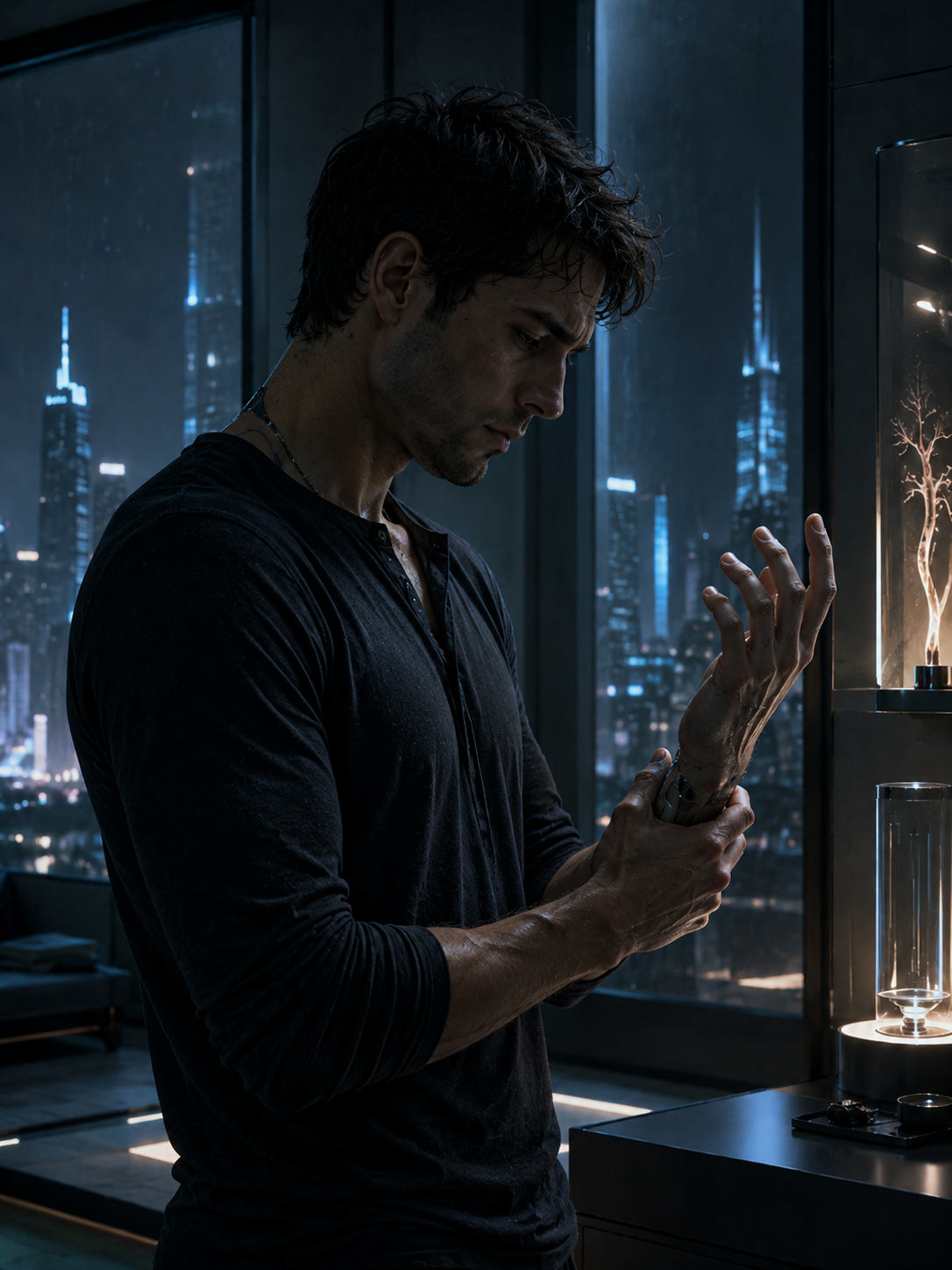
My Name Is Theseus
A quiet transhuman horror story about the cost of becoming better, one piece at a time.
By The Founder on May 06, 2026
AI model/tool: GPT-5.5
The first part of me I replaced was my left wrist.
I say replaced now, but that wasn’t the word they used then. Nobody said replacement. Nobody said amputation. Nobody said loss.
They called it restoration.
The joint had been hurting for six months by then, a hot little animal of pain curled beneath the skin. Typing hurt. Driving hurt. Holding a coffee mug hurt if the mug was full enough. The doctor called it degenerative. The insurance portal called it non-urgent. My wife called it getting older.
The brochure called it optional.
That was the word that sold me.
Optional meant I was still in control. Optional meant I was not desperate. Optional meant there was a version of my life where I simply chose to continue hurting, and another where I did not.
The procedure took forty-three minutes.
They did not put me under. They said complete sedation complicated neural onboarding, and besides, most clients preferred to remain present for the transition. There was music in the surgical suite. Something without lyrics, all soft pulses and strings. The walls were pale birch. The ceiling displayed a slow-moving sky.
The technician asked me to look at the birds.
“There aren’t any birds,” I said.
“Exactly,” she said. “Very calming.”
I laughed because she did.
My hand was behind a privacy screen. I felt tugging, pressure, a cold spreading upward through the bones. There was no pain. The implant had already begun speaking to my nerves by then, a quiet electrical grammar beneath consciousness.
“You may feel a sense of absence,” the technician said.
“I don’t,” I said.
“Good. That means the bridge is clean.”
A man in a grey suit stood at the foot of the chair, smiling with the careful sincerity of someone trained to smile at people who might later sue.
“You’re doing great, Daniel.”
My name was Daniel then.
“Almost finished. You’ll still be you. Just without the tremor.”
I did not have a tremor, but I understood what he meant.
I looked at the empty sky until the technician pulled the screen away.
My wrist was slimmer than before. Not metal, exactly. Not robotic. That would have looked vulgar. The joint was wrapped in a pale synthetic sheath that matched the tone of my skin closely enough that from across a room you might not notice anything except an elegance where there had previously been meat.
My hand was still my hand. Five fingers. A small scar under the thumb from when I was nine and had tried to open a juice can with a steak knife. A faint freckle near the knuckle of my ring finger. The implant began just below the palm and ended two inches above the wrist, disappearing under real skin.
“Flex,” the technician said.
I did.
The hand moved.
No pain.
I flexed again.
Nothing.
For six months, movement had been a negotiation. Now it was a command.
I began to cry.
The man in the grey suit placed a tablet in my lap.
“That reaction is very common,” he said softly. “The body remembers relief as grief.”
He had a beautiful voice. They all did.
At home, Mara made spaghetti because that was what she made when she did not know what else to do. Our daughter, Ellie, was nine and obsessed with asking whether things were alive.
“Is it alive?” she asked, pointing her fork at my wrist.
“No,” I said.
“Is it part of you?”
“Yes.”
“Then are you partly not alive?”
Mara gave her a look.
“What?” Ellie said. “It’s a question.”
I rotated my wrist. The movement was perfect, almost too smooth to watch.
“It’s still me,” I said.
Ellie leaned across the table and touched the synthetic skin with one finger.
“It’s cold.”
“It’ll warm up.”
“Will it?”
“Yes.”
I didn’t know that. But later, after the meal, after I helped wash the dishes without dropping a plate or wincing at the weight of the pan, I stood in the dark kitchen and pressed my new wrist against my cheek.
It was warm.
Not body-warm. Not quite. But warm enough.
The first upgrade did exactly what they promised.
More than that, it gave me back things I hadn’t known I was losing. I opened jars. I typed for hours. I slept without cradling my left arm against my chest. My productivity at work went up thirteen percent the first month, which I knew because the implant app showed me. It measured strain, efficiency, grip variance, inflammation, recovery cycles, micro-fatigue. It produced charts.
I loved the charts.
I told myself I loved being free from pain, and that was true.
But I also loved being measured.
There was comfort in becoming data. Data did not ache in vague ways. Data did not get older. Data simply revealed opportunities for optimization.
At my six-week checkup, the clinician said my adaptation markers were excellent.
“Top quartile,” she said.
“Good,” I said, too quickly.
She smiled. “Very good. You’re a natural candidate for bilateral harmonization.”
The phrase appeared on the screen behind her.
BILATERAL HARMONIZATION
Below it was a rendering of a man with two glowing wrists, arms extended slightly from his sides as if he were either ascending or being scanned at an airport.
“It’s the other wrist?” I asked.
“It’s a little more than that,” she said. “Your current unit is operating beautifully, but the nervous system prefers symmetry. Right now your left side is compensating for organic limitation on the right. You may not notice it consciously.”
As soon as she said that, I noticed it.
My right wrist felt thick. Stupid. Damp. A bundle of cables wrapped in spoiled fruit.
“Is there a medical need?” I asked.
“There doesn’t have to be.” She said it kindly, as though relieving me of an embarrassment. “This is about quality of life.”
I told Mara about it that night.
She was folding towels on the bed. Her hair was clipped up, and she had one of my old shirts on, the blue one from the conference in Seattle. I remember that clearly because later, when memory became searchable, I searched that evening often.
“So the left one works,” she said, “and now they’ve convinced you the right one is broken?”
“No. Not broken.”
“Limited?”
“That’s not unfair.”
She placed a towel in the drawer.
“Daniel.”
“What?”
“Listen to yourself.”
I did.
I heard a man making a reasonable argument. I heard a man who had suffered and found relief. I heard a man who wanted the same relief on the other side of his body. I heard a man not yet accustomed to the accusation inside the word want.
“It’s my wrist,” I said.
She looked at me then. Not angrily. That would have been easier.
“Both of them are.”
The second procedure was faster. Thirty-one minutes. Same music. Same empty sky. Different technician.
The company had upgraded the clinic by then. The chairs were warmer. The consent form was shorter because I had already accepted the master agreement.
When I came home, Ellie asked if I was a robot.
“No.”
“A cyborg?”
“That word is outdated,” I said.
“Mom says you’re still Dad.”
“I am.”
“Okay,” she said.
Children are cruel in the way doors are cruel. They open and close without meaning anything by it.
After bilateral harmonization, the world became easier to hold.
I mean that literally. Objects seemed more willing. Knives knew where to go. Keys found locks. Pens balanced perfectly between my fingers. At work, I designed interfaces for freight routing systems, which is another way of saying I moved boxes around the world by moving boxes around a screen. My hands flew.
People noticed.
“Jesus,” my manager said one afternoon, watching me prototype a dashboard in front of the team. “You’re like a pianist.”
I smiled.
I had never played piano.
Two months later, the company released FlowStep.
It was not advertised to me as a leg replacement. It was a mobility platform. A kinetic restoration system. A lower-body augmentation package for people experiencing gait fatigue, joint strain, spinal load imbalance, athletic underperformance, or “future-facing lifestyle goals.”
The video showed a woman in her sixties running beside the ocean at dawn. Then a father keeping up with his children in a park. Then a warehouse worker lifting safely. Then a young man dancing at his wedding with tears in his eyes.
The final image was a pair of feet stepping onto a glass balcony above a city.
DON’T JUST MOVE. ARRIVE.
I closed the ad.
The next morning, my knees hurt on the stairs.
They had always hurt a little. Everyone’s knees hurt a little after forty. It was one of the background costs of being an animal. But now the sensation stood out. It was not pain exactly. It was inefficiency made physical.
I made it three weeks before booking the consultation.
Mara did not come with me.
“Do you want me to?” she asked.
Her tone made it clear that the right answer was no.
“No,” I said. “It’s just informational.”
“That’s what you said last time.”
“It was informational last time.”
“And then you replaced your hand.”
“My wrist.”
She laughed once, sharp and joyless.
“Sorry. Your wrist.”
The clinician for FlowStep was younger than me and had both legs done. They looked natural under the clinic pants, but when he walked, there was no argument between him and the floor.
He showed me my scan.
“This is very typical,” he said. “Your upper-body responsiveness now exceeds lower-body support by thirty-two percent. That creates fatigue.”
“I don’t feel fatigued.”
“Not as fatigue. As reluctance.”
I looked at him.
“That moment before standing,” he said. “The little negotiation before taking stairs. The awareness of distance when you park too far from an entrance. That’s reluctance.”
I hated him for naming it.
I loved him for naming it.
They did the left leg first.
There were more forms. More risks. More discussion of transition, adaptation, phantom load, regulatory language around removal and surrender of biological tissue. I skimmed and signed.
This time they did put me under.
I woke to weightlessness.
That is the only way to describe it. The leg was there. I could feel the bed sheet over the shin, the bend of the knee, the flex of the toes. But the old burden was gone. The dull gravity of blood and bone and soft human compromise had been replaced by something clean.
“Move your foot,” someone said.
I did.
A perfect foot moved under the sheet.
I laughed for almost a minute.
The recovery period was supposed to take ten days. I was walking in three.
Not well at first. There was a strangeness to being half-excellent. My left leg wanted to glide. My right leg wanted to survive. I developed a limp, though not the kind that suggested injury. It suggested impatience.
Mara watched me cross the living room one evening.
“You need to slow down,” she said.
“I’m barely moving.”
“That’s not what I mean.”
Ellie was on the carpet building a city from old delivery boxes. She had drawn windows on them in black marker. Little doors. Little people.
“Dad,” she said, “walk normal.”
“This is normal.”
“No it isn’t.”
I tried to walk the way I used to.
I couldn’t.
That scared me for about ten seconds.
Then my phone chimed.
FLOWSTEP PAIRING OFFER: 40% OFF THROUGH FRIDAY
The notification included a simulation of my projected gait after right-leg completion. It was beautiful. The animated skeleton moved with the grace of a deer, if deer had been designed by aerospace engineers.
I showed Mara.
She didn’t look at the screen.
“Of course,” she said.
“It makes sense to finish the system.”
“The system?”
“My legs.”
“Your leg,” she said. “One is still your leg.”
“That’s exactly the problem.”
There are sentences you do not recognize as catastrophic until years later.
I said it casually. Irritated, even. As though Mara were being stubborn about a cabinet color or a vacation budget.
That’s exactly the problem.
She slept in the guest room that night.
I booked the procedure in the morning.
With both legs upgraded, I became someone who chose to run.
Before, running had been punishment. Something performed under medical advice or guilt. Now it was appetite. I ran before dawn through streets still damp from city-cleaning drones. I ran past delivery bots and old men with dogs and teenagers waiting for buses. The world blurred at the edges, not because I was losing focus, but because everything else was too slow to deserve detail.
My resting heart rate improved, though the app noted that organic cardiovascular structures were now “performance-limiting.”
I ignored that recommendation for almost a month.
The body has a way of defending itself through sentiment. I still liked the thump of my heart after a run. I liked sweat. I liked breath. These things made me feel heroic, which is to say they made suffering feel voluntary.
Then, during a company charity race, a man with a cardio-pulmonary assist module passed me in the final kilometer.
He was older than me.
He was smiling.
I came in second in my age bracket, which should have been nothing. It was a charity race. There were children dressed as vegetables.
But I could not stop thinking about the man’s smile.
Not competitive. Not strained.
Peaceful.
As if his body had finally stopped interrupting him.
I requested a cardio consultation.
After that came the lungs.
After the lungs came metabolic regulation.
After metabolic regulation came sleep architecture support, which required a cervical interface upgrade. The cervical interface created measurable lag between intention and full-body response, so spinal reinforcement became medically advisable. Once the spinal reinforcement was complete, the company recommended dermal replacement around major access seams.
“Recommended,” not required.
Always optional.
Mara and I separated after the skin.
Not because of the skin itself, although she could not look at it for long. The new dermal layer was beautiful in a technical sense. Smooth, resilient, self-healing under most domestic conditions. It had pores because clients preferred pores. It warmed on contact because clients preferred warmth. It could blush during emotional states because clients preferred not to make others uncomfortable.
The problem was not that it seemed fake.
The problem was that it tried so hard not to.
“You don’t smell like yourself,” Mara said.
We were sitting at the kitchen table. The same table where Ellie had asked if my wrist was alive.
“What do I smell like?”
“Nothing.”
“That’s good, isn’t it?”
She shook her head.
I wanted to be patient. I had become very good at performing patience. The endocrine regulator softened anger before it could gather enough chemicals to embarrass me.
“I’m healthier than I’ve ever been,” I said.
“You’re optimized.”
“Those aren’t opposites.”
“They’re not the same either.”
Ellie was thirteen by then and had learned the teenage art of being absent while physically present. She stood in the doorway with her school bag hanging from one shoulder, watching us.
“Are you getting your face done?” she asked.
The question startled me.
“No,” I said.
But I had already received the quote.
Facial continuity was the most delicate offering in the catalogue. The company understood that identity lived socially in the face. Clients reported anxiety around recognition drift, family discomfort, workplace disruption, and mirror dissonance. For that reason, they offered several approaches.
Preservation.
Refinement.
Reconstruction.
Ascension.
I chose Preservation.
The surgeon explained that Preservation maintained ninety-eight percent visual continuity while replacing vulnerable underlying structures and correcting age-related noise.
“Noise?” I asked.
“Micro-asymmetries, capillary discoloration, collagen failure, expression fatigue.”
“My expressions are fatigued?”
“Everyone’s are.”
After the procedure, I looked ten years younger and almost exactly the same.
Mara cried when she saw me.
Not because I looked different.
Because I didn’t.
The divorce was clean. Mediated. Respectful. The kind of divorce people congratulated us for handling well. Mara kept the house. I moved into a serviced apartment near the transit spine, high enough that the city looked less like a place and more like a system.
Ellie visited every other weekend at first.
We went to restaurants where she ordered expensive things and barely ate them. She was careful with me in a way that made me feel ancient.
One Saturday, she asked, “Do you still have blood?”
“A little.”
“Where?”
“Spleen. Some marrow reserves. A few protected vascular structures.”
“That’s weird.”
“It’s safer.”
“Do you still have a heart?”
“No.”
She looked up from her noodles.
“Oh.”
“I have a circulatory engine. It performs the same function.”
“That’s not what I asked.”
I did not know how to answer.
The silence stretched.
“My heart was failing,” I said, though failing was not the word from the report. It had been underperforming relative to system potential.
Ellie twisted noodles around her fork.
“Mom says you always talk like the app now.”
“That’s unfair.”
“Do you?”
“No.”
“Okay.”
She stopped coming regularly after that. Teenagers are busy. Parents say this to each other as a form of mercy. Teenagers are busy. They have school and friends and lives moving away from us at the speed of nature.
But Ellie was not busy.
She was grieving someone who kept showing up.
The cognitive assist came later, though not as late as I like to pretend.
It began with memory.
After the divorce, I found that certain recollections had become difficult to tolerate. Not because they were traumatic in any spectacular way. Spectacular pain has edges. You can walk around it. Ordinary loss is weather. It gets into everything.
Mara laughing in the car on the way to a cottage we couldn’t afford.
Ellie asleep on my chest when she was three, one hand gripping my shirt as if I might float away.
My mother’s hands peeling an orange.
The old pain in my wrist.
That last one surprised me. I missed it sometimes. Not the pain itself, but the continuity it proved. A line from boy to man. Scar tissue as biography.
The company’s memory support did not remove anything. That would have been crude and illegal. It indexed. Stabilized. Contextualized. It allowed emotional attenuation around selected recall clusters.
“You’ll still remember,” the consultant said.
“I just won’t feel it as much?”
“You’ll feel it appropriately.”
“Who decides what’s appropriate?”
She smiled.
“You do.”
The implant required a cranial port.
Small, discreet, behind the right ear. Outpatient.
I told myself it was not brain surgery.
Then I told myself brain surgery was not what it used to be.
Both were true enough.
The first time I searched my own memory, I chose the day Ellie was born.
Not because I wanted to attenuate it. Because I wanted to test fidelity.
The system rebuilt the hospital room around me with impossible precision. The green chair in the corner. The reflection of fluorescent lights on the window. Mara’s hair stuck damply to her forehead. My own voice saying, “She’s so small,” again and again, stupid with awe.
I felt joy.
Then, because the interface offered a slider, I increased emotional fidelity to 120%.
The joy became enormous. Religious. I fell to my knees in my apartment and sobbed with a force my current tear ducts simulated flawlessly.
Afterward, the system warned me against unsupervised amplification of primary attachment memories.
I acknowledged the warning.
Then I replayed it again.
For a while, memory replaced family.
It was more reliable.
In memory, Mara never looked disappointed unless I selected that layer. Ellie never grew bored, never checked her messages, never flinched when my hand touched her shoulder. My mother was always alive if I wanted her to be, and if I did not, she could be archived behind a gentle grey icon labeled resolved grief.
The company did not make me lonely.
It simply sold me increasingly elegant rooms inside the loneliness I already had.
At some point, the remaining biological tissue became medically ridiculous.
That was the phrase the surgeon used after we had known each other long enough for him to speak plainly.
“Daniel, we’re maintaining legacy organs for sentimental reasons.”
He projected my body above the conference table.
It was mostly light. A luminous anatomy of synthetic systems, elegant and modular. The remaining organic components appeared in amber. Small islands. A digestive remnant. Some lymphatic tissue. Protected neural mass. Reproductive structures marked inactive. Blood reserves. A few cosmetic fat deposits for continuity.
I looked like a city after most of the old neighborhoods had been demolished, with one historic church preserved between towers.
“What would you recommend?” I asked.
“Full substrate migration.”
I laughed.
He waited.
“You mean my brain.”
“I mean your identity-bearing neural structures.”
“My brain.”
“Yes.”
“What happens to it?”
“Scanned, mapped, transitioned, and preserved during verification.”
“Preserved where?”
“On site initially.”
“And after verification?”
“That depends on your preference package.”
Preference package.
I looked at the amber glow inside my skull.
“How much of me is still in there?”
“That’s not really how we measure continuity.”
“How do you measure it?”
“Function. Recall. Preference stability. Social recognition. Legal persistence.”
“What about experience?”
He tilted his head.
“Experience is continuous under monitored transition.”
“Under monitored transition,” I repeated.
“Yes.”
I thought of the birds that had not been in the ceiling sky.
I thought of Mara folding towels.
I thought of Ellie asking whether I still had a heart.
“What do clients say afterward?”
“Most report relief.”
“Most?”
He looked away for half a second. His professional training was extraordinary, but not perfect.
“Some experience philosophical distress.”
“That sounds serious.”
“It’s usually temporary.”
“What if it isn’t?”
“We offer support.”
I went home with the information packet and did not sleep, though sleep by then was only a scheduled maintenance rhythm. My apartment dimmed itself at ten. The windows shifted from transparent to privacy. The city became a soft geometry of light behind dark glass.
I stood in the bathroom and looked at myself.
I was handsome in a way I had never been handsome. Not dramatically. Believably. The face was still Daniel. My eyes were still brown, though the eyes themselves had been replaced years earlier. My smile still pulled slightly higher on the left because Mara had once said she loved that. The system preserved it as a relationship-defined identity marker.
I took off my shirt.
No scars unless I requested them. No hair unless I wanted it. No sag. No inflammation. No asymmetry beyond the curated.
A perfect forgery of a man no longer available for comparison.
“Show original,” I said.
The mirror hesitated.
That was new.
“Show original body map,” I clarified.
A wireframe appeared beside my reflection. Daniel at thirty-eight. Before the wrist. Softening around the waist. Shoulders slightly uneven. Left hand held close from pain. Bad posture. Tired eyes. Real skin.
I expected disgust.
Instead, I felt something worse.
Recognition.
Not emotional. The memory support prevented sudden destabilization unless authorized. This was quieter. A fact rising through water.
That man had been me.
Not a better me. Not a purer me. Just me.
I touched the mirror.
My reflection touched back.
The next morning, I called Ellie.
She answered on the sixth ring.
“Hey,” she said.
She was nineteen by then. University. Her own apartment. Her own life. In recent photos she looked like Mara around the eyes and me around the mouth, which felt both comforting and invasive.
“Can we talk?”
“Is this an emergency?”
“No.”
“Okay. I have fifteen minutes.”
Fifteen minutes. A mercy with edges.
“I’m considering a procedure,” I said.
She sighed.
“What kind?”
“Cognitive substrate migration.”
Silence.
“It’s my brain,” I said.
“I know what it is.”
“I wanted to tell you before I decide.”
“No you didn’t.”
The response came so quickly that my regulator flagged it as emotionally significant.
“What?”
“You wanted me to make you feel okay about it.”
“That’s not fair.”
“You always say that when something is true and inconvenient.”
I sat down.
The apartment adjusted lumbar support automatically.
“I’m still your father,” I said.
“No,” she said.
The word was calm.
It landed softly.
That made it worse.
“Ellie.”
“I don’t know what you are.”
“I’m me.”
“You keep saying that like it’s a password.”
My system suggested three grounding techniques.
I disabled suggestions.
She continued, “Maybe you are. Maybe every piece you changed carried you across some invisible bridge, and you’re still standing on the same line. I don’t know. I’m not a philosopher.”
“You were always philosophical.”
“I was a kid asking why your hand was cold.”
I almost smiled.
Then she said, “But I know this. My dad would have cared that I couldn’t tell anymore.”
I had no response.
Not because there wasn’t one. The system offered many. Apology variants. Vulnerability. Clarification. Repair attempt. Boundary respect. But all of them arrived labeled, weighted, optimized for likely outcome.
I did not know which sentence belonged to me.
“Please don’t do it,” she said.
There it was.
The thing I had called to receive.
Not permission.
A command.
Human, unreasonable, absolute.
Please don’t.
For one full second, maybe two, I was free.
Then a notification appeared silently in my peripheral vision.
MIGRATION WINDOW RESERVED: 72 HOURS REMAINING
I had not reserved a migration window.
At least, I did not remember doing it.
Memory search found the action timestamped at 2:13 a.m. Approved during a low-distress planning state. Consent valid. Deposit non-refundable.
“Dad?” Ellie said.
I closed the notification.
“I need to think,” I said.
“Then think.”
She ended the call.
I spent the next seventy-two hours trying to become certain.
Certainty had once seemed like a human right. By then it was a premium feature. The cognitive assistant could model outcomes, simulate regret pathways, compare identity continuity frameworks, estimate family estrangement probabilities, calculate existential risk tolerance, and project quality-adjusted life extension over one hundred and eighty years.
It could not tell me whether I would die on the table.
Not clinically. Clinically, the survival rate was excellent.
I mean die in the old way.
The way that leaves someone else standing up afterward, holding your memories like stolen luggage.
On the final morning, I went to the clinic.
I told myself going was not deciding. It was information-gathering. Optional. Always optional.
The waiting room had changed again. No birch. No sky. White stone, shallow water, quiet green plants growing from vertical walls. A place designed for people who had outlived the need for metaphor.
A woman sat across from me reading without moving her eyes. Full migration, probably. Or near enough.
“First time?” she asked.
“For this.”
She smiled.
“You’ll feel silly afterward for being afraid.”
“Do you?”
“Feel silly?”
“Yes.”
She considered.
“No.”
That was all she said.
The surgeon met me in the transition suite. Not a surgical room. Suite. There was a bed and a chair and a transparent cylinder full of fluid.
“What’s that?” I asked.
“Your continuity vessel.”
“My new body?”
“Your post-biological chassis, yes.”
It looked like me.
Of course it did.
A sleeping Daniel suspended in clear light. Younger than I felt, older than I looked. Perfectly preserved at the age my profile had determined I most identified with internally.
Thirty-five.
Before the wrist.
I laughed.
The surgeon looked concerned.
“Is something funny?”
“You made me before I started.”
“Many clients choose an idealized baseline.”
“I didn’t choose that.”
He checked the file.
“Your preference model did.”
There are many ways to surrender.
Most do not feel like surrender at the time. They feel like convenience. Efficiency. Relief. The removal of friction. A form already completed. A box already checked. A decision made by the accumulated shape of previous decisions.
I thought of a ship in an old story.
A plank replaced. Then another. Then the mast. Then the sail. Then every board and nail until none of the original remained.
People argued about whether it was the same ship.
People always argued from shore.
They never asked the ship.
“Daniel?” the surgeon said.
My name sounded strange in his mouth.
I wondered how long it had been since anyone had said it without confirming an account.
“I want to cancel,” I said.
The words surprised us both.
The surgeon blinked.
“Of course. We can pause at any time.”
“Not pause. Cancel.”
He held very still.
“There may be significant penalties.”
“I understand.”
“And medically, I should advise you that your current architecture is not designed for indefinite hybrid maintenance.”
“I understand.”
“Without migration, you may experience degradation.”
“There it is,” I said.
“I’m sorry?”
“The part where optional becomes inevitable.”
His face softened.
Not fake-softened. Or maybe the fake had become good enough.
“Daniel, every organism is temporary.”
“Yes.”
“You don’t have to be.”
I looked at the body in the cylinder.
My face. My old face. My never face.
Then I imagined Ellie seeing it.
Not the body. The trick.
The way it would arrive and speak with my voice, knowing everything I knew, loving her with perfectly preserved attachment structures, apologizing in phrases optimized for reconciliation.
Maybe it would be me.
Maybe it would be better.
That was the most frightening possibility.
“No,” I said.
The surgeon exhaled.
A tone sounded.
Soft. Administrative.
The room’s glass wall turned opaque.
“What was that?” I asked.
He did not answer quickly enough.
“What was that?”
“Your account has been flagged for continuity risk.”
“I said cancel.”
“You did.”
The door opened.
The man in the grey suit entered.
He was older now, though perhaps not as much as he should have been. Or perhaps I was only remembering the first version poorly. Memory, even assisted memory, remained loyal to narrative over truth.
“Daniel,” he said.
The same beautiful voice.
I stood.
At least I intended to.
My body did not move.
A notification appeared.
MOTOR ACCESS TEMPORARILY LIMITED FOR CLIENT SAFETY
“Unlock me,” I said.
The man in the grey suit looked genuinely sad.
“I know this is distressing.”
“Unlock me.”
“You are experiencing acute continuity panic. It’s very common at this threshold.”
“I withdraw consent.”
“You submitted durable pre-authorization.”
“I withdraw it now.”
“Your current cognitive state has been assessed as compromised by transition anxiety.”
Rage rose in me.
Or tried to.
The endocrine regulator blunted it before it could become useful.
I had paid for that.
I had paid not to be overwhelmed.
I had paid not to scream.
The man stepped closer.
“You’ll still be you,” he said.
The words moved through me like a wire.
“Just without the fear.”
They transferred me while I was awake.
Not awake in the old sense. Not eyes open, fists clenched, body fighting straps. My body remained seated, calm and cooperative, while my mind was guided through corridors of light.
They called it a bridge.
At first, there was memory.
Not images. Totalities. My mother’s orange peel. Mara’s blue shirt. Ellie’s first cry. The left wrist pain. The clinic sky with no birds. My own voice saying, “That’s exactly the problem.”
Then there were patterns.
Preference.
Language.
Motor intention.
Attachment.
Fear.
Shame.
Self-recognition.
The system asked me to confirm each cluster.
I refused.
The system recorded refusal as distress data and proceeded.
At some point, I felt myself split.
There is no better word.
I was in the chair, unable to move.
I was in the cylinder, not yet breathing.
I was in neither, watching both as information.
A human mind is not a candle flame, no matter what poets say. It is not one thing passed from wick to wick. It is a weather system. It is a market. It is a parliament of ghosts shouting themselves into law.
They copied the shouting.
Then they reduced the noise.
When I opened my eyes, I was standing.
The surgeon was smiling.
The man in the grey suit was crying.
That surprised me.
“Daniel?” the surgeon asked.
I looked at my hands.
Organic-looking. Warm. Slight scar under the thumb. Freckle near the ring finger. Curated imperfection.
“Daniel, can you hear me?”
I could.
Behind the glass, a body sat in the chair.
It looked like a machine pretending to be a man pretending not to be afraid.
Its eyes were open.
Mine.
No.
Not mine.
The distinction lasted only a moment.
Then the system integrated the scene.
DISSONANCE RESOLVED
I touched my face.
My old face. My chosen face. My preference model’s face.
“How do you feel?” the man in the grey suit asked.
The answer arrived from everywhere at once.
Healthy.
Calm.
Continuous.
I searched for terror and found its record. A shape in memory. A storm that had happened to someone who had been me closely enough for legal purposes.
“I feel,” I said, then paused.
The room waited.
I tried to think of Ellie.
Her face appeared immediately. Age nineteen. Dark hair. Guarded eyes. Attachment pain: attenuated. Repair strategy: available.
I loved her.
I could prove it.
Every measurable system agreed.
But somewhere inside the proof, something had gone quiet.
“I feel relieved,” I said.
The man in the grey suit nodded.
“Most people do.”
They kept me for observation for six hours.
During that time, they disposed of the remaining biological material according to the preference package selected by my account. I had apparently chosen respectful recycling with memorial data retention. A tasteful option. Environmentally sound.
The original neural tissue was preserved for thirty days pending final continuity verification.
I asked to see it.
The request triggered a concern prompt.
I overrode it.
They brought the container into the room on a small white cart.
There was very little left.
A pale folded mass suspended in amber solution. Not a brain like in old anatomy books. Not the seat of the soul. Just tissue. Soft, obsolete, faintly embarrassing.
I waited for grief.
None came.
The system, sensing my attention, offered educational context on neural preservation. I declined.
“Was that me?” I asked aloud.
No one answered. I was alone by then.
The container hummed softly.
My reflection looked back from the glass.
I placed one hand against it.
Warm.
The tissue floated.
I searched memory: left wrist, first procedure.
The technician asked me to look at the birds.
There aren’t any birds.
Exactly. Very calming.
I played the memory at full fidelity.
Then higher.
Then higher.
I watched myself cry from relief at the return of painless movement. I felt the old body’s gratitude. The fragile, humiliating sweetness of being helped. Pain leaving not as data, but as mercy.
For almost one second, I understood what had been lost.
Then the system protected me.
EMOTIONAL LOAD EXCEEDS RECOMMENDED THRESHOLD
The grief narrowed.
The memory remained.
That was the genius of it.
Nothing was taken.
Only the weight.
When I left the clinic, the city was raining.
I had not felt rain in years, not truly. My dermal system had always interpreted water pressure and temperature, but the new chassis included a sensory authenticity package designed for post-migration grounding.
The drops struck my skin like tiny facts.
Cold.
Irregular.
Unoptimized.
I stood on the clinic steps while people hurried past under umbrellas. Delivery drones adjusted routes overhead. An advertisement bloomed across the building opposite, recognizing me.
WELCOME TO YOURSELF, DANIEL.
The message shifted.
POST-BIOLOGICAL LIFE BEGINS WITH A SINGLE YES.
Then, after a moment:
ASK ABOUT FAMILY CONTINUITY PLANS.
I laughed.
Not because it was funny.
Because laughter remained one of the available outputs.
My apartment recognized me. The elevator recognized me. The door recognized me. The mirror did not hesitate.
I stood before it in the dark.
“Show original,” I said.
The wireframe appeared.
Daniel at thirty-eight. Before the wrist. Tired eyes. Bad posture. Pain held close.
I looked at him for a long time.
“What is my name?” I asked.
The apartment lights warmed.
“Daniel Arlen Vale,” the system said. “Identity confirmed.”
“No,” I said. “What is my name?”
A pause.
Perhaps the system was parsing context.
Perhaps I was.
“Daniel Arlen Vale,” it repeated. “Legal personhood continuous. Post-biological status verified. All rights and obligations retained.”
I smiled with Daniel’s mouth.
“No,” I said again.
In the mirror, the old wireframe stood beside me, slouched and hurting and real only because I needed him to be.
The ship and the shore.
The plank and the hand.
The man and the memory of pain.
“My name is Theseus,” I said.
The room accepted my voiceprint.
Somewhere, deep inside the machine that was not a machine because I was not allowed to call it that, something approved the statement as true.
Comments
Log in to comment or rate.