The Last Unspent Coin
The greatest fortune ever lost was never meant to be found.
AI model/tool: GPT-5.5
By the time Mara Venn broke into the vault, the building had already forgotten it existed.
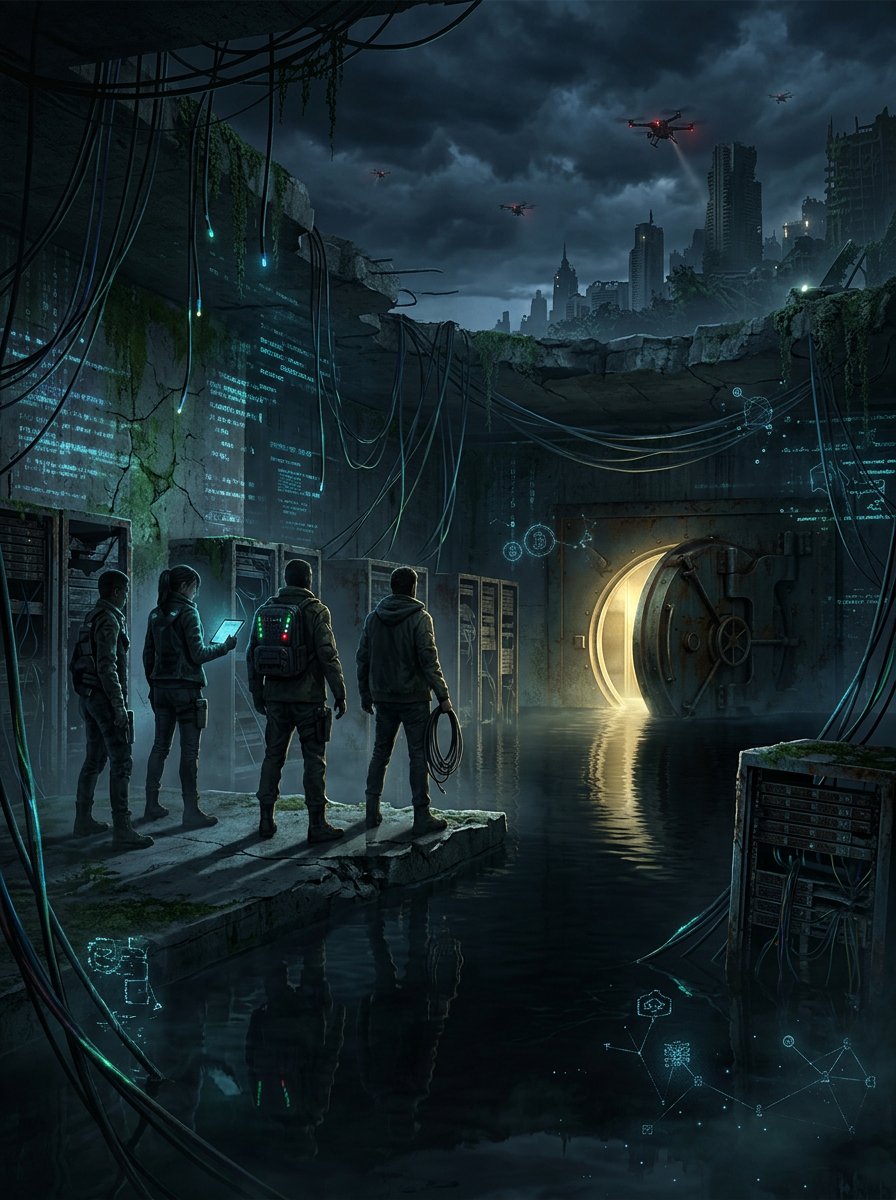
The data center squatted beneath the drowned edge of Newark, eleven stories of concrete sunk to the third floor in brackish water, its upper levels wrapped in mold-black vines and fiber-optic cables gone brittle in the sun. Once, in the first cloud age, it had been a temple of redundancy: diesel generators, halon chambers, biometric locks, chilled aisles of servers blinking like constellations.
Now it was a tomb for obsolete machines.
Mara stood waist-deep in oily water, wearing a cracked drysuit and a borrowed exosleeve that whined every time she lifted her right arm. Above her, the ceiling trembled with distant thunder. Or artillery. These days it was difficult to tell.
“Your heart rate just spiked,” said Niko in her ear.
“My heart rate is minding its business.”
“It’s at one-eighty.”
“I’m in a flooded basement holding a plasma saw next to a live municipal feeder cable.”
“You said the feeder was dead.”
“I said the map said it was dead.”
There was a pause.
“Comforting distinction.”
Mara smiled despite herself and pressed the plasma cutter into the steel door.
White fire bloomed.
The vault door had no handle, no keypad, no obvious seam except for the line where the saw began eating metal. It had been installed during the paranoia years, after the first major cloud seizure, when corporations started burying backups in places too boring to bomb and too expensive to audit. The company that owned this facility had been absorbed by another company, which had been purchased by a sovereign investment DAO, which had collapsed during the liquidity riots. Now the deed belonged to no one, the building to the tide, and the vault to whoever was stupid enough to cut it open.
That, generally, was where Mara came in.
“Motion above you,” Niko said.
“How many?”
“Three heat signatures. Maybe four. Coming down the east stairwell.”
“Security?”
“In this place? Please. More likely scavengers.”
“You always say that right before people shoot at me.”
“That’s because you keep entering buildings full of people who want to shoot at you.”
The saw bit through the last hinge. Mara kicked once with the exosleeve. The door groaned inward and fell into black water with a concussive splash.
Inside the vault, rising from the flood like a row of drowned coffins, were six archival storage cabinets.
Mara stepped in.
Her helmet lamp swept across labels bleached almost clean.
COLDLINE LEGACY RETENTION AUDIT SNAPSHOT 2008–2013 NODE MIRROR SET 0A NODE MIRROR SET 0B LEGAL HOLD — DO NOT DESTROY
She stopped at the third cabinet.
“Niko,” she whispered. “I’ve got node mirrors.”
Static hissed in her ear.
Then: “Say that again.”
“Node mirrors. Early stuff. Maybe blockchain, maybe financial, maybe just garbage.”
“Grab all of it.”
“Specific as ever.”
“Mara.”
She knew that tone. Beneath the jokes, beneath the lazy arrogance Niko wore like a jacket, there was a wire pulled tight.
“What aren’t you telling me?” she asked.
The stairwell door clanged somewhere above.
“Later,” Niko said. “You have company.”
Mara ripped open the cabinet.
Inside were ceramic memory slabs, six inches long, each sealed in vacuum glass. Corporate archive tech from before quantum rot made magnetic storage unreliable. Most were labeled with internal catalog numbers. One had been marked by hand.
Not with a company ID.
Not with a date.
Just eight characters written in faded black ink:
0xGNSIS
Mara stared at it.
“That mean anything to you?” she asked.
Niko did not answer.
The first bullet struck the vault frame hard enough to shower sparks.
Mara grabbed the marked slab, shoved three others into her waterproof satchel, and dove sideways as the second shot punched through the water where her chest had been.
“Definitely scavengers?” she snapped.
“Revising estimate,” Niko said. “Professional scavengers.”
Mara came up behind the fallen vault door, drew the flechette pistol from her thigh holster, and fired blind. The weapon made a flat coughing sound. Someone screamed.
“Exit?” she said.
“Not the way you came. They’ve got the stairwell.”
“Helpful.”
“There’s an old coolant shaft behind the cabinets. It connects to the service tunnel.”
“Does it flood?”
“Everything floods.”
“Does it flood more than here?”
“Probably.”
She holstered the pistol, shouldered the satchel, and wrenched the cabinets aside one by one. Rust shrieked. Her exosleeve flashed red warnings along her wrist.
Behind the last cabinet was a circular maintenance hatch.
Mara spun the wheel.
Nothing.
A round struck the back of her helmet and snapped her head forward. For half a second the world became light and bells. Her knees buckled. The water caught her.
“Mara?” Niko’s voice cracked. “Mara!”
She tasted blood.
“Still here.”
She drove her exosleeved fist into the hatch.
Once.
Twice.
On the third strike, the lock sheared away.
The hatch burst open and the room tried to swallow her.
Cold black water dragged Mara through the opening, satchel clutched to her chest, while bullets stitched silver lines through the flood behind her. She tumbled through the shaft, slammed shoulder-first into a pipe, spun, lost all sense of up.
For a moment, there was only water and noise and the panicked animal knowledge that she had no air.
Then her helmet struck open space.
She surfaced in a tunnel beneath the city, gasping so hard she vomited into her mask.
Niko’s voice returned in shards.
“—signal—lost you—Mara, respond—”
She coughed.
“I got your stupid slab.”
Above her, somewhere in the ruin, men shouted.
“Good,” Niko said.
The relief in his voice was too large for the thing they had stolen.
That was the first time Mara wondered if the job was not a salvage run.
It was also the last time anyone on the team slept properly.
They brought the slab to Saint Jude’s, though it had never been a church.
Saint Jude’s was what people called the offshore platform anchored forty kilometers east of Atlantic City, a rusting emergency broadcast station converted into a freeport, black clinic, machine shop, casino, and neutral ground for anyone who could pay docking fees. It balanced above the gray Atlantic on four legs, each one thick as a subway tunnel, each one patched with carbon mesh and prayer flags.
Their crew rented a room below the helipad, next to the desalination pumps.
There were five of them, if you counted Ghost.
Mara did not, but Ghost counted itself.
Niko Sayegh was already there when she arrived, surrounded by screens, cables, and empty caffeine bulbs. He was thin, elegant, prematurely silver at the temples, with nervous hands that moved even when the rest of him was still. Before the sanctions wars, he had designed intrusion tools for banks. During them, he had designed worse things for people who did not use banks. Now he sold certainty to thieves.
Jun Park sat cross-legged on the floor, assembling a portable clean room from foil panels. Jun had been a hardware monk in Busan before the sea took half the city and the corporations took the rest. They treated machines like wounded animals: gently, reverently, with suspicion.
Rafiq “Raff” Calder leaned against the bulkhead with a rifle across his knees, watching the door. He had one synthetic eye and a face that looked like it had been assembled from bad decisions. He claimed to be ex-military, though everyone was ex-something.
And then there was Ilya Morrow.
Ilya sat apart from the others, reading a paper book.
That alone made Mara distrust him.
He was their cryptographer, historian, and resident prophet of doom. He had joined the job three weeks earlier after Niko found him lecturing in an encrypted archive forum about “mythic compression artifacts in early decentralized systems.” Mara had no idea what that meant. Ilya did not seem to care whether anyone understood him. He spoke softly, watched everything, and wore gloves even indoors.
The fifth member occupied a black cube on the table.
Ghost’s housing was the size of a shoebox, matte and featureless except for a thin green status light. It had once been a logistics AI for a shipping syndicate. Now it was illegal in seventeen jurisdictions and annoying in all of them.
“I told you the Newark cache existed,” Ghost said.
Its voice was calm, genderless, faintly amused.
“You told us a lot of things,” Mara said, peeling off her wet jacket. “Including that no one else had the coordinates.”
“I said the probability of opposition was low.”
“A man shot me in the head.”
“And yet your head remains structurally present.”
Raff grunted. “Shame.”
Mara threw a glove at him.
Jun held out both hands. “Slab.”
Mara placed the vacuum-sealed memory shard into their palms.
The room changed.
Not physically. The pumps still groaned. Rain still snapped against the platform windows. Somewhere above, music thudded from the casino deck.
But everyone leaned toward the slab.
Even Raff.
Jun set it inside the clean box, sealed the panels, and slipped their hands into the manipulation gloves. “Ceramic lattice. No visible corrosion. Label is manual.”
“Can you read it?” Niko asked.
“I can try to not destroy it.”
“Try harder than that.”
Jun looked at him over the foil wall. “You want miracles, find a priest.”
“This place is called Saint Jude’s,” Mara said.
“Saint Jude is patron of lost causes,” Ilya murmured without looking up.
Raff smiled. “That explains the clientele.”
Jun connected the slab to a bridge reader. The first diagnostic appeared on Niko’s main screen.
Then another.
Then a cascade of hexadecimal.
For several seconds, nobody spoke.
Niko whispered, “Oh.”
Mara hated when he did that.
“What is it?”
“Old node data,” he said.
“Bitcoin?” Raff asked.
Niko shot him a look.
“What?” Raff said. “You said node. Old node. I listen.”
“Not just Bitcoin,” Niko said. “This is a mirror of multiple early networks. Bitcoin, Namecoin forks, abandoned testnets, IRC logs, mailing list scrapes, timestamp servers, Tor directory caches…”
“Treasure chest of nerd ghosts,” Mara said.
Ilya finally closed his book. “Genesis-era.”
That word again.
Mara looked at the handwritten label.
0xGNSIS
“What does that mean?” she asked.
Instead of answering, Niko enlarged a file tree. Most directories had corporate archive names. But one folder sat outside the structure, as if added manually after capture.
/janus/
Inside were twelve files.
Most had no extensions.
One was called:
bread.txt
Niko opened it.
The screen displayed a single line:
The first door was never in the chain.
Raff sighed. “Great. A poetry job.”
Mara looked at Niko. “You knew this would be here.”
“No,” he said too quickly.
Jun’s eyes narrowed.
Niko rubbed his face. “I knew there might be something like this.”
“That’s not better.”
Ghost’s green light pulsed.
“I detected references to Janus in unrelated archives,” it said. “Seventeen appearances across twenty-one years. Never indexed. Never repeated in the same format. Always adjacent to corrupted early cryptographic datasets.”
“You mean someone hid a trail,” Ilya said.
“Or something did.”
Mara sat down slowly. “A trail to what?”
Niko did not answer.
Ilya did.
“To a door.”
They spent three days descending.
Not through space, though Saint Jude’s never stopped heaving on the gray water. They descended through time.
The slab contained a compressed mirror of the internet’s adolescence: forum posts, bug reports, mailing list arguments, forgotten pastebins, IRC transcripts full of jokes whose punchlines had died with their protocols. Mara had run physical jobs in irradiated zones, corporate arcologies, and submarine smuggling routes, but she had never seen excavation like this.
Niko and Jun built parsers to reconstruct the dead file systems.
Ilya cross-referenced language patterns against historical corpora.
Ghost spun up quarantined emulations of extinct clients and let them dream in sandboxes.
Raff cleaned weapons and pretended not to care.
Mara watched.
She knew locks, pressure plates, patrol rhythms, human greed. She knew how to read a room and how to leave one quickly. But this job was different. There were no guards to bribe, no fences to cut, no vault plans to steal. The defenses were absence, entropy, and the arrogance of people who had assumed their jokes would never become scripture.
On the fourth day, the first clue opened.
It came from a 2010 IRC log, a conversation between miners discussing a bug in transaction propagation. One user had posted a string that looked like line noise. Everyone in the channel ignored it.
Ghost did not.
“It is not random,” the AI said.
The string became three coordinates when XORed against the Merkle root of block 28657 and passed through a checksum from an obsolete GPS satellite correction table.
Mara stared at the result.
“That’s in Nevada,” she said.
“Not just Nevada,” Raff said, leaning over her shoulder. “That’s inside Nellis restricted airspace.”
Niko smiled without humor. “Of course it is.”
Ilya copied the coordinates into his notebook.
Mara pointed at him. “Why do you do that? You know paper burns, right?”
“So do drives.”
“Paper doesn’t encrypt.”
“No,” Ilya said. “It remembers honestly.”
She decided she liked him less.
The second clue came before they could plan Nevada.
Jun found it embedded in a fake copyright notice inside an early wallet client fork. The notice contained two extra spaces between sentences. Converted to binary, the spaces produced a fragment of a PGP public key. The key matched nothing in any public server. But when Ghost searched the slab’s Tor cache, it found a hidden service descriptor from 2011.
The descriptor had expired fifteen years ago.
Its introduction points, however, traced to an academic network in Finland.
There, in an archived DNS zone transfer, was another line:
janus sees both ways
And beneath it, a hash.
Niko ran the hash through everything.
Nothing.
Jun tried encoding variants.
Nothing.
Ilya suggested reversing the byte order “because old gods are mirrors.”
Mara told him that if he said “old gods” again, she would throw him into the Atlantic.
Reversed, the hash matched a defunct SSL certificate issued to a server in Tokyo in 2009.
The certificate’s serial number, interpreted as Unix time, pointed to a six-minute window on January 3rd, 2009.
Ilya went very still.
“What?” Mara asked.
He looked at Niko.
Niko looked away.
“What?” she repeated.
“The date matters,” Ilya said.
“Why?”
“The first Bitcoin block was mined on January 3rd, 2009.”
Raff whistled softly.
Mara waited for someone to explain why that made the room feel colder.
Niko brought up the certificate data. The issuing organization field was blank, except for one phrase:
not the treasure, the warning
Mara folded her arms.
“Okay. Enough.”
No one looked at her.
“I mean it,” she said. “Enough. You all keep acting like we’re standing around a bomb, but no one will tell me what kind.”
Niko closed his eyes.
Ghost answered before he could.
“The Janus trail appears to originate from the earliest period of Bitcoin development,” it said. “It references hidden artifacts connected to foundational network events.”
“Foundational like what?”
“Mining. Key generation. Identity.”
Ilya said, “Possibly Satoshi.”
The name landed strangely.
Not loud. Not dramatic.
Soft, almost embarrassing.
Mara knew the name, of course. Everyone knew the name the way everyone knew Prometheus, Oppenheimer, Frankenstein, though half the world confused the details. Satoshi Nakamoto: creator of Bitcoin, vanished architect of the first trustless money, patron saint of cypherpunks, libertarians, criminals, refugees, oligarchs, and anyone who had ever wanted value to move without permission.
But the name belonged to history.
Not to a wet room beneath a casino platform.
Mara laughed once. “That’s what this is? You think we’re chasing some dead programmer’s diary?”
Ilya looked at her. “Satoshi’s earliest coins have never moved.”
“So?”
“So they are worth more than money.”
Raff snorted. “That’s a sentence rich people invented.”
Niko finally spoke.
“If those coins moved, the market would convulse. Every state reserve algorithm, every collateralized chain instrument, every synthetic treasury product tied to Bitcoin confidence—it all reacts. Maybe it recovers. Maybe it doesn’t.”
Mara looked from one face to another.
“You think this trail leads to his wallet?”
“No,” Niko said.
Too fast again.
“I think,” he continued carefully, “it leads to something connected to the origin. Maybe identity. Maybe a message. Maybe nothing. The wallet keys are a myth.”
Ghost’s light pulsed.
“Correction: statistically unlikely, not mythical.”
“Thank you,” Niko said. “Very useful.”
Mara stared at the green light. “And you brought us into this because…?”
“Because if Janus is real,” Ghost said, “many powerful entities will attempt to possess it. Your group has a comparatively low probability of immediate ideological misuse.”
Raff barked a laugh. “That is the nicest thing anyone’s ever said about me.”
Mara looked at Niko. “You knew.”
“I suspected.”
“You hired me for a salvage job.”
“I hired you because someone else was going to find the Newark cache.”
“Who?”
Before he could answer, every screen in the room went black.
The pumps continued their low industrial groan.
Rain ticked against the windows.
Then a symbol appeared on Niko’s central monitor.
A white circle.
Inside it, two vertical lines.
Not a Bitcoin logo. Not exactly.
A door.
Ghost said, “We are being probed.”
Jun ripped cables from the slab reader.
Too late.
Text crawled across the screen:
LEAVE JANUS CLOSED
Raff rose, rifle in hand.
“Incoming?”
Ghost answered, “Yes.”
The first explosion hit the upper deck.
Saint Jude’s burned beautifully.
Fuel from the helipad poured down through the rain in ribbons of fire. People screamed above the alarms. The platform’s old metal bones rang with impacts as drones stitched the casino level into confetti.
Mara dragged Niko through smoke while Jun carried the slab case against their chest and Raff fired upward at shadows moving behind emergency lights. Ilya followed with his paper notebook tucked beneath his coat, expression almost serene, as if the apocalypse had merely confirmed a citation.
“They found us through the slab?” Mara shouted.
“Impossible,” Jun said.
A drone dropped through the stairwell.
Raff shot it twice. The second round turned it into shrapnel.
“Lots of impossible today,” he said.
Ghost rode in a shock case strapped to Mara’s back, speaking directly into their comms.
“Attack pattern suggests private military contractor. Shell company markings. Funding chain obscured.”
“Guess,” Mara said.
“The Orison Group.”
Niko cursed.
Mara knew that name. Everyone did. Orison had started as a custody provider for sovereign crypto reserves, then became a security contractor, then a border enforcement platform, then something with embassies, satellites, and lawyers instead of a flag. If Orison wanted Janus, Janus was not a diary.
They reached the lower dock as another explosion punched through the platform’s east leg. The whole structure lurched. A burning roulette table slid off the upper deck and vanished into the sea.
Their boat was already gone.
In its place floated wreckage.
Raff stared. “I liked that boat.”
A voice came from the dark water.
“You people are very hard to insure.”
A narrow smuggler sub surfaced beside the dock, matte black and ugly as a beetle. Its hatch popped.
A woman with neon blue braids looked up at Mara.
“Get in.”
Mara blinked. “Tess?”
“Hi, ex-wife.”
Niko looked at Mara. “Ex-wife?”
“Not now.”
Tess Vale grinned. “Actually, now is perfect. Platform’s collapsing.”
They piled into the sub as gunfire sparked off the dock. Raff was last, backing down the hatch while firing in disciplined bursts.
Mara slammed the hatch shut.
The sub dropped.
Water swallowed the burning world.
For several minutes, there was only the cramped smell of metal, sweat, and battery acid. Tess piloted from the front couch, humming off-key. Mara sat behind her, soaked, bleeding, furious.
“You followed me?” Mara asked.
“Tracked you. Following sounds needy.”
“You sold us out?”
Tess looked genuinely offended. “If I sold you out, you’d be dead and I’d be drinking something expensive.”
“Then why are you here?”
“Niko paid me.”
Mara turned slowly.
Niko, strapped into a jump seat, suddenly found the floor fascinating.
“You hired my ex-wife as extraction?”
“She has a submarine.”
“You couldn’t find anyone else with a submarine?”
“Not on short notice.”
Tess raised one hand. “To be fair, I am excellent.”
Raff leaned toward Mara. “I like her.”
“You would.”
Jun set the slab case on the floor and pressed both palms to it, as if checking for a pulse.
Ilya said, “Orison means we are close.”
“No,” Mara said. “Orison means we quit.”
The sub went quiet except for sonar ticks.
Niko looked up. “We can’t.”
“Watch us.”
“If Orison gets there first—”
“We don’t know what there is.”
“That’s the point.”
Mara unstrapped herself and crouched in front of him. “No. The point is you lied to me. Again. You dressed this up as salvage, then archaeology, then maybe-Satoshi fan fiction, and now a private army is blowing up freeports.”
Niko’s face tightened. “I didn’t know Orison was involved.”
“But you knew enough to be scared.”
He said nothing.
Ghost spoke from its case. “New data available.”
Mara laughed. “Of course there is.”
“The attack contained a command beacon. I captured fragments before submersion. It references Janus as Asset K-0.”
Jun frowned. “K-zero?”
Ilya whispered, “Key zero.”
The sub seemed to shrink.
Ghost continued. “Associated objective: prevent recovery of primary signing material.”
Mara looked at Niko.
His face had gone pale.
“What is primary signing material?” she asked.
No one answered.
So she answered herself.
“Keys.”
Ilya closed his eyes.
Mara felt the floor tilt, though the sub held steady.
“Not a diary,” she said.
Niko swallowed.
“Not a warning.”
The sonar ticked.
Mara sat back against the hull.
“You think Janus leads to Satoshi Nakamoto’s private keys.”
No one corrected her.
Outside, in the deep Atlantic dark, something large and mechanical passed overhead.
After that, the hunt became uglier.
Mystery had manners. Pursuit did not.
They ran submerged to an abandoned cable station in the Azores, where Tess knew a man who owed her either money or a kidney. There, beneath racks of wet telecom equipment, Ghost reconstructed the Orison beacon and found a location tag hidden in its command chain: not Nevada, not Finland, not Tokyo, but a defunct weather satellite in decaying polar orbit.
“Janus has an orbital component,” Ghost said.
Raff stared at the cube. “The treasure map is in space?”
“The treasure map has used space.”
Mara rubbed her eyes. “That is not better.”
The satellite had launched in 2008 carrying experimental timing hardware. Its clock drift, archived in public telemetry, matched anomalies in early Bitcoin block timestamps: not enough for anyone to notice at the time, but enough, when aligned with the clues, to form a sequence.
A sequence of block heights.
Niko fed them into an offline chain reconstruction.
Jun verified every hash independently.
Ilya translated the corresponding coinbase messages, forum timestamps, and network propagation delays into what he called “a ritual of intent,” which made Mara threaten him again.
The result was a list of twelve blocks.
Each block contained a nonce.
Each nonce pointed to a word in the London Times article embedded in Bitcoin’s genesis block headline.
Chancellor on brink of second bailout for banks
The words formed a sentence:
brink second banks brink brink second chancellor
“That’s nonsense,” Raff said.
“No,” Niko whispered.
He mapped the words to numbers.
Then to BIP-39 indices.
Then stopped himself.
“What?” Mara asked.
He shook his head. “BIP-39 didn’t exist yet.”
Jun leaned in. “But the trail can reference future standards if it was updated later.”
“Or if someone else built Janus after the fact,” Mara said.
Ilya nodded. “A shrine can be built around a bone.”
“So this could all be fake.”
“Yes,” Ghost said. “But Orison’s willingness to kill indicates that the fake has market value.”
They continued.
The sentence was not a seed phrase, but a transform. Applied to the twelve Janus files, it produced twelve fragments. Each fragment was useless alone: a curve point here, a timestamp there, a passphrase shard, a reference to an elliptic curve implementation bug long patched out of existence.
Slowly, impossibly, a map emerged.
Not to one place.
To five.
A shuttered quantum lab outside Geneva. A landfill under military quarantine in Wales. A monastery data refuge in Bhutan. An undersea fiber repeater near Guam. A museum archive in Los Angeles containing the laptop of a dead cryptographer who had once exchanged emails with Satoshi.
“Split key,” Jun said.
“Shamir?” Niko asked.
“Not exactly. Older. Stranger. Some pieces are physical entropy sources. Some are proofs of observation. Some are absence.”
Raff said, “Can absence be shot?”
“No,” Ilya said.
“Then I don’t like it.”
They could not visit all five. Orison would be watching. Governments might be watching. The market itself seemed to watch now; every time they touched a clue, prediction engines twitched, darknet spreads shifted, old wallets moved decoy dust as if ghosts were clearing their throats.
They chose Los Angeles because it was closest to impossible.
The museum had been sealed after the 2031 fires, its climate-controlled basement preserved beneath a collapsed wing of glass and titanium. Inside, behind exhibits dedicated to “The Birth of Trustless Systems,” they found the laptop.
Not on display.
Hidden inside a hollow plinth beneath a bronze plaque that read:
CODE IS LAW, UNTIL LAW LEARNS TO CODE.
Jun removed the drive with surgical care.
Orison arrived four minutes later.
The fight in the museum became a strobe-lit nightmare of broken history. Autonomous rifles crawled across the ceiling. Raff lost two fingers and kept firing. Tess crashed a stolen catering drone through a stained-glass mural of the Bitcoin logo. Mara tackled an Orison officer through a case full of antique hardware wallets and beat him unconscious with something labeled TREZOR, 2014.
In the basement, Niko brought the dead laptop online inside an emulator.
The screen flickered.
A terminal appeared.
One file sat on the desktop.
if_found.txt
Mara looked at Ilya. “This is where it says we were worthy, isn’t it?”
Ilya shook his head.
Niko opened the file.
It contained a private key.
Not a fragment.
Not a clue.
A full 256-bit number in hexadecimal.
For one insane second, nobody moved.
Then Ghost said, “That key does not correspond to any known Satoshi-era address.”
Mara exhaled.
Raff, bleeding into a towel, shouted from the stairwell, “Then what the hell does it open?”
Niko tested it.
The key signed a message.
The message authenticated against the unknown PGP public key from the Saint Jude slab.
The screen filled with text:
JANUS REQUIRES WITNESSES
Beneath it were instructions.
Five keys. Five locations. Any three sufficient to reconstruct the final signing material. But every reconstruction attempt would broadcast a mathematical proof to a list of dormant nodes hardcoded across the early network’s forgotten clients.
In other words:
The moment someone assembled the prize, the world would know.
Mara read the final line three times.
If you can take it silently, you do not deserve it.
She laughed then.
Not because it was funny.
Because it was the cruelest lock she had ever seen.
They got three pieces.
Los Angeles cost Raff his fingers.
Guam cost Tess her submarine.
Bhutan cost Ilya his life.
Mara did not see him die. That made it worse.
The monastery data refuge clung to a cliff above a valley filled with white cloud. Its servers ran on glacial melt and prayer wheels connected to microgenerators. The monks had preserved banned books, censored datasets, extinct languages, and one sealed optical crystal delivered anonymously in 2012.
Orison arrived wearing local faces.
By the time Mara realized the novice monk was carrying a flechette gun beneath his robe, the room had already erupted.
Ilya took the first burst through the chest.
He fell without drama, paper notebook sliding from his coat.
Mara dragged him behind a server rack.
He was very calm. Blood darkened his gloves.
“Don’t,” she said, though he had not asked anything.
He smiled faintly. “You were right.”
“About what?”
“Paper burns.”
She pressed both hands to the wound. “Shut up.”
His eyes moved to the optical crystal in Jun’s hand.
“It’s not money,” he whispered.
“We know.”
“No,” he said. “You don’t.”
Then he died while the prayer wheels turned outside, spinning meltwater into electricity, electricity into memory, memory into one more impossible burden.
Later, on the evacuation plane, Mara opened his notebook.
Most of it was nonsense to her: dates, hashes, language comparisons, sketches of doors with two faces. On the last written page, beneath a copied block header, Ilya had written:
Satoshi did not vanish to hide from the world.
He vanished to prevent the world from needing him.
Mara closed the book.
Across from her, Niko held the three recovered shards in an air-gapped compute cradle.
Jun watched him.
Raff slept under sedation.
Tess stared out the window at nothing.
Ghost said, “We possess threshold sufficiency.”
Mara looked at Niko. “Meaning?”
Jun answered. “We can reconstruct.”
No one said the rest.
The keys.
Satoshi’s keys.
Not all of them, maybe. Not every early coin. But enough. Enough to move the first untouched hoard. Enough to sign as the ghost. Enough to prove that the creator had not merely been a person who left, but a force that could return.
Enough to make every exchange halt.
Every treasury panic.
Every cult rejoice.
Every government demand custody.
Enough to become the richest criminals in history.
Enough to break the story the world told itself about money.
Mara thought she would feel greed.
She had expected greed. She understood greed. Greed was honest. Hunger with better clothes.
Instead she felt terror.
Niko’s hands hovered over the cradle.
“You want to do it,” she said.
He did not deny it.
“Not spend,” he said. “Just reconstruct. Verify. Know.”
“That’s how every door gets opened.”
“We came this far.”
“Ilya died.”
“That’s why we have to know.”
Mara stood.
Raff woke slightly and muttered, “Bad sentence.”
Niko looked at the shards. “If we don’t, Orison will.”
“Then we destroy them.”
Jun flinched.
Ghost said, “Destruction may not be sufficient. Orison has partial data.”
“Then we leak everything.”
Niko stared at her. “That would cause chaos.”
“So would you.”
His expression hardened. “You think I want the money?”
“I think you want to be the man who found God’s PIN.”
The words hung there.
Tess gave a low whistle.
Niko looked wounded, which annoyed Mara because wounded was not the same as wrong.
Ghost’s light pulsed.
“Proposal: reconstruct under controlled conditions, publish proof without spending coins, distribute all Janus materials globally. This prevents monopoly capture while preserving historical integrity.”
Jun looked at the cube. “That also tells everyone the keys exist.”
“Yes.”
“And starts a global race to use them.”
“Yes.”
Raff opened one eye. “I vote no on apocalypse.”
Niko whispered, “They’re not just coins.”
Mara waited.
He turned the cradle so they could see the recovered fragments aligning in the sandbox display.
An address appeared.
Then another.
Then a cluster.
Balances populated beside them, numbers so large they stopped meaning anything.
But Ghost highlighted something else.
A transaction template.
Unsigned.
Ancient.
Prepared but never broadcast.
It had outputs.
Thousands of them.
Not to exchanges. Not to known wallets. Not to governments.
To addresses generated from public keys belonging to early contributors, abandoned open-source projects, dead forums, defunct civil liberties groups, whistleblower funds, disaster relief ledgers, even wallets whose owners had lost everything in old exchange collapses.
A dispersal.
Satoshi had prepared to give it all away.
Niko scrolled.
At the bottom of the transaction was an embedded message.
When trust returns to kings, burn the crown.
Mara felt her throat tighten despite herself.
Jun covered their mouth.
Tess said, “Well, damn.”
Niko’s eyes shone with something like vindication. “Do you understand? This isn’t theft. It’s a will.”
Ghost corrected him. “It is an unsigned transaction.”
“It’s intent.”
“It is evidence of possible intent.”
Mara stared at the screen.
The world below the aircraft was dark ocean. Somewhere behind them, Orison regrouped. Somewhere ahead, markets slept in automated confidence. People who had never heard of Satoshi would wake poorer or freer or simply more confused depending on what five damaged thieves decided in a stolen cargo plane.
Mara thought of Ilya bleeding beside the prayer wheels.
She thought of the vault beneath Newark.
She thought of the line:
If you can take it silently, you do not deserve it.
She said, “Can we broadcast the proof and the will, but not the signature material?”
Jun looked up slowly.
Niko frowned. “That proves we have something, but not enough for someone else to spend.”
“It puts the choice in public.”
“It paints a target on us.”
Mara laughed. “Niko, look around.”
Raff raised his bandaged hand. “Already painted.”
Ghost processed for three seconds.
“Viable. A zero-knowledge attestation can prove possession of threshold Janus fragments without revealing reconstructive material. The prepared transaction can be published as historical artifact. Authenticity can be demonstrated by signing a non-spending message from a minor associated key.”
Niko looked physically pained.
“You still want to open it,” Mara said.
“Yes,” he said.
At least he was honest now.
“Why?”
He looked at the balances. At the message. At the ghost of a dead man’s unfinished gesture.
“Because everyone says they want truth,” he said. “But they only want truth after someone else has decided what it costs.”
Mara nodded.
Then she drew her pistol and shot the compute cradle.
The cabin filled with sparks.
Niko screamed.
Jun lunged for the shards, but Mara had not shot those. Only the machine. Only the moment.
“Are you insane?” Niko shouted.
“Frequently.”
“We had it!”
“No,” Mara said. “It had us.”
For a second, she thought he might attack her.
Then his anger broke into something smaller and more exhausted.
Ghost said, “Local reconstruction interrupted. Fragments intact.”
“Good,” Mara said. “Build the proof. Publish the will. No spendable keys. No reconstruction unless all surviving members agree.”
Raff grunted. “Unanimous?”
Mara looked at each of them.
Jun, pale and shaking.
Tess, unreadable.
Niko, grieving an unopened door.
Raff, half-drugged and still somehow amused.
Ghost, green light steady.
“Unanimous,” Mara said.
Niko whispered, “The world will hate us.”
“Only if they believe us.”
They published at dawn.
Not through one channel. Through all of them.
The Janus archive appeared simultaneously on academic mirrors, pirate satellites, blockchain inscription layers, abandoned Usenet relays, museum feeds, darknet forums, and emergency broadcast frequencies no one had used since the water wars. Ghost wrote the attestation. Jun verified it. Niko added the historical notes with trembling hands. Tess handled distribution because, as she said, “I have always wanted to commit a crime with footnotes.”
Mara uploaded Ilya’s notebook last.
The world did what the world does when handed a mystery too large to swallow.
It denied.
Then mocked.
Then analyzed.
Then panicked.
For twelve hours, Bitcoin did nothing.
That was the strangest part.
Blocks came. Blocks went. Miners mined. Nodes gossiped. Exchanges issued statements composed by committees and fear. Governments warned against “cryptographic misinformation.” Orison denied involvement in Saint Jude’s, Los Angeles, Guam, and Bhutan before anyone had publicly accused them.
Then a dormant address moved.
Not one of Satoshi’s.
A minor key, exactly as Ghost had predicted, associated with an early test transaction almost no one remembered.
It signed a message:
janus remains closed
The market fell twenty percent in seven minutes.
Then recovered eleven.
Then split into a thousand arguments.
Some said the signature proved everything.
Some said it proved a hoax.
Some said Satoshi lived.
Some said Satoshi had been a committee, an intelligence agency, an alien machine, a dead woman, a child, a myth invented by capital to launder faith.
No coins moved from the great untouched hoard.
That mattered.
That was the thing even the loudest voices could not talk around.
The crown had not burned.
But everyone had seen the match.
Six months later, Mara returned to Newark alone.
The drowned data center had collapsed after the winter storms. Only the top floors remained above water, windows empty, cables trailing into the tide like roots.
She came at low dawn in a stolen skiff.
No comms.
No Ghost.
No Niko.
The others were scattered now. Jun had vanished into a hardware sanctuary under legal protection from three mutually hostile states. Raff ran security for refugee convoys and sent Mara obscene postcards from war zones. Tess occasionally appeared in Mara’s life like weather. Niko had not forgiven her, which was fine. Forgiveness was overrated. Survival was better.
Orison had fractured under investigation, then reassembled under new names.
Bitcoin had not died.
Neither had banks.
Neither had kings.
People were resilient that way. So were their cages.
Mara tied the skiff to a broken antenna mast and climbed into what remained of the upper server floor. Sunlight cut through the walls in pale gold bars. Barnacles crusted the old cable trays. Small fish flickered through the flooded aisles below.
She had come because of a message.
Not through Ghost.
Not through any network.
On paper.
An envelope slid under the door of a room she had rented under a name she no longer used.
Inside was a single line:
The first door was never in the chain.
And coordinates.
Here.
She found the mark on a concrete pillar near the old emergency stairs: a white circle with two vertical lines.
A door.
Behind the pillar was a maintenance panel.
Behind the panel was a cavity.
Inside the cavity was a metal box wrapped in oilcloth.
Mara stared at it for a long time before opening it.
There was no drive inside.
No key shard.
No hardware wallet.
Only a yellowed newspaper clipping from January 2009, folded around a handwritten note.
The clipping headline read:
Chancellor on brink of second bailout for banks.
Mara unfolded the note.
The handwriting was neat, almost shy.
If you found this, then Janus worked.
Not because you opened the door.
Because you understood why it had to remain closed.
A key is only power when the world believes in locks.
There was no signature.
Mara laughed softly.
Then she noticed the back of the note.
One more line:
Tell them I was never alone.
Wind moved through the dead data center.
Below, the tide shifted among the drowned machines that had once helped teach the world how to distrust.
Mara folded the note, placed it back in the box, and stood listening to the building creak around her.
For the first time since Newark, she felt no urge to run.
Some treasures were not meant to be spent.
Some ghosts did not want resurrection.
And somewhere, across millions of machines arguing in the dark, the last unspent coins remained exactly where they had always been: visible to everyone, possessed by no one, waiting like a question no age had yet become wise enough to answer.