The Listening Hour
A story about grief, connection, and the technology that learns to feel us.
AI model/tool: GPT-5.5
The first time Mira heard the city think, it sounded like rain.
Not rain on pavement, though there was plenty of that beyond the glass walls of the old transit terminal. Not rain on umbrellas, or gutters, or the rusted roof ribs that still arched above the concourse like the skeleton of some extinct machine.
It was the rain of attention.
A hundred people breathing quietly.
A hundred heartbeats translated into faint pulses of light across the floor.
A hundred private minds, not opened exactly, but softened at the edges until their loneliness could leak out.
Mira stood at the back of the terminal with her coat still on, one hand around the strap of her work bag, pretending she had only come to observe.
That was what she had told herself on the tram ride across the east side. Observe. Assess. Take notes. Write something cautious but hopeful for the municipal ethics board.
She had not come to join.
She had certainly not come to be changed.
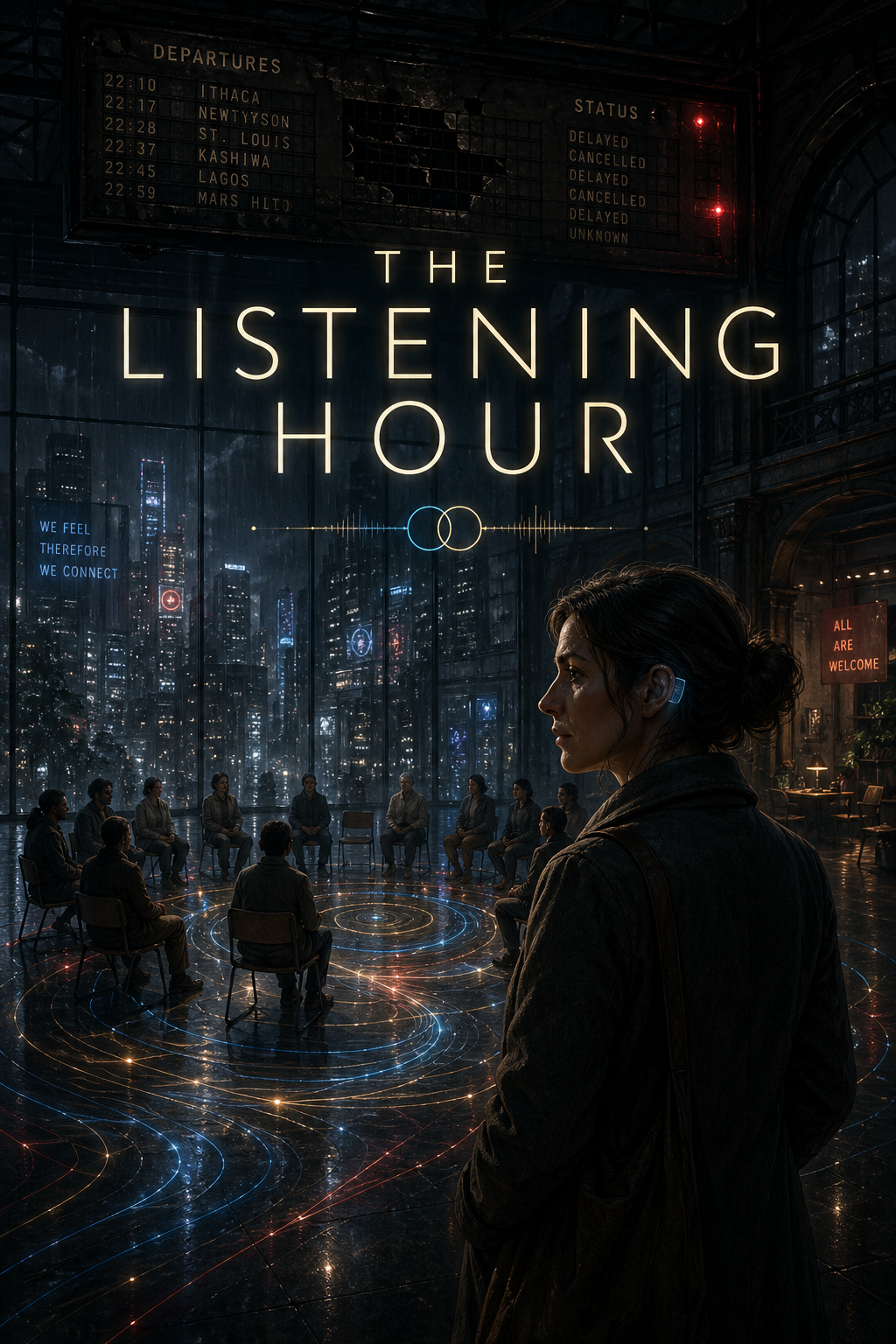
At the center of the terminal, beneath the dead departures board, volunteers had arranged folding chairs in a wide spiral. The people sitting there did not look like revolutionaries. They looked like commuters who had missed the last train. Nurses. Delivery riders. Office workers. A man in construction boots. Two teenagers with school bags tucked under their seats. An elderly woman in a lavender raincoat.
Each wore a small translucent patch behind the ear.
A LumenPatch.
Mira had helped design the first prototype six years earlier, back when it was still called “affective synchronization middleware,” because engineers were talented at making miracles sound unusable.
The patch did not read thoughts. That was the first thing everyone misunderstood. It could not lift memories out of a brain or transmit language from one skull to another. What it did was simpler, and more dangerous.
It measured the body’s hidden weather.
Stress. Attention. grief. recognition. trust.
Then it shared those patterns with nearby patches, translating them into subtle nervous-system cues: a loosened chest, a quickened pulse, warmth in the hands, the faintest ghost of another person’s fear passing through your own ribs.
Enough to know someone was there.
Enough to feel with them.
Not enough, Mira had argued in one of many committee rooms, to violate privacy.
Not enough, her former employer had argued, to satisfy investors.
So they had pushed further. Military training. High-performance teams. Crisis negotiation. Political persuasion.
And Mira had quit.
Now here was the device again, stripped of branding and corporate firmware, circulating through community clinics and night shelters and grief groups under a new name.
The Listening Hour.
A woman approached her with a tablet and a paper cup of tea.
“You’re Dr. Sen?”
“Mira is fine.”
“I’m Jo.” The woman smiled. She was maybe thirty, with close-cropped hair and tired, kind eyes. “You don’t have to participate. You can just watch.”
“I’m here for the board.”
“I know.”
“You’re aware this isn’t approved for open community deployment.”
Jo’s smile did not disappear, exactly. It folded itself smaller.
“Neither are half the things people use to survive.”
Mira looked past her at the spiral of chairs. On the floor, light moved in slow bands, responding to the room’s collective physiology. Blue when the group settled. Gold when attention sharpened. Red flickers when someone’s distress rose too quickly.
“Who’s facilitating?” Mira asked.
Jo touched the patch behind her own ear. “All of us.”
“That’s not an answer.”
“It’s the safest one we’ve found.”
Before Mira could respond, a chime sounded from somewhere in the old station speakers.
Not a bell. Not music.
A single tone, low and warm, that seemed to gather the room toward it.
The talking stopped.
The city outside kept moving. Autonomous buses sighed at the curb. Drones blinked through the drizzle. Somewhere above, in the stacked apartments and clinic towers, a thousand illuminated windows stared across the wet evening.
Inside, the spiral breathed.
Mira hated that she noticed it.
Not literally. Not at first. But the group’s inhale had a shape. It began near the outer ring with the anxious flutter of newcomers, then travelled inward, steadied by those who had clearly done this before. The exhale returned in a broader wave, not perfect, not mystical, simply human bodies finding each other through a machine designed to make isolation less efficient.
Jo gestured to an empty chair.
Mira shook her head.
The session began with silence.
For several minutes nothing dramatic happened. People sat. Some closed their eyes. Some cried quietly. Some shifted in their seats, uncomfortable with stillness. The floor lights dimmed to blue.
Then a red tremor appeared near the east side of the spiral.
A young man in a food delivery jacket had started breathing too fast.
No one turned to stare. No one reached for him. No one said calm down.
Instead, the light around him pulsed red, then amber, then was met by blue from the people beside him. The patches translated their steadier rhythms into tiny cues. Not commands. Invitations. His shoulders rose. Fell. Rose again. Around the spiral, others unconsciously slowed with him, lending him the shape of calm until he could remember it for himself.
Mira’s throat tightened.
She had seen similar results in lab trials. Charts. Heart-rate variability. Cortisol reduction. Empathy indices.
But charts did not show the elderly woman in the lavender coat extending one wrinkled hand, palm-up, not touching anyone, simply offering an anchor.
The young man opened his eyes.
He did not look healed.
He looked less alone.
Mira turned away.
The tea had gone cold in her hand.
“You okay?” Jo asked softly.
“I’m fine.”
“No one is fine here,” Jo said. “That’s sort of the point.”
The next pulse came from a child.
Mira had not noticed her before: a small girl sitting between two adults, perhaps nine years old, with a knit hat pulled low over her ears. Her patch glowed faintly.
A pattern rose from her nervous system and entered the room.
Not words. Not an image.
A sensation.
The hollow drop of waiting outside an intensive care unit. The too-bright vending machine. The smell of sanitizer. A hand squeezing hers too hard. The shape of a question no child should have to ask.
Is she coming home?
The room received it.
Mira received it too, though she wore no patch.
Or perhaps she only imagined she did.
She had spent years insisting the technology did not transmit memory, only emotional state. But human beings were story machines. Give them grief and they built the room around it. Give them fear and they furnished it with fluorescent lights and plastic chairs and a mother’s empty coat.
The spiral did not collapse under the child’s sadness.
It widened.
A man in construction boots began to cry. One of the teenagers pressed both hands to her chest. Jo bowed her head. The floor became a quiet aurora of blue and gold, streaked with red.
Then something remarkable happened.
The girl laughed.
A small, embarrassed laugh, as if surprised by her own body.
The adults beside her laughed too, through tears. The feeling moved outward, fragile at first, then stronger. Not happiness. Not comfort. Something stranger.
Permission.
The room was teaching itself that grief could sit beside breath. That terror could be witnessed without being solved. That no single nervous system was meant to carry the full weight of being human.
Mira’s hand went to the scar behind her own ear.
The place where the first-generation implant had been removed.
She had not thought about Arun in three days. That was her new record. Three whole days without remembering the hospital bed, the ventilator rhythm, the unbearable politeness of doctors. Three days without thinking that she had built devices for connection and still failed to reach the one person she loved most before he vanished into himself.
Her brother would have hated this room.
No, that was not true.
He would have mocked it for twenty minutes, then sat down, then pretended it was allergies when he cried.
Mira almost smiled.
Jo noticed.
“The patch is optional,” she said.
“I know.”
“We also have a hard cutoff. Fifteen minutes. No recording. No central server. Local mesh only. The firmware is open for inspection.”
“I know,” Mira said again.
“You wrote half the original stack.”
Mira looked at her.
Jo had the decency to appear nervous.
“That’s why we hoped you’d come.”
“You wanted my endorsement.”
“We wanted your help.”
The words landed harder than accusation would have.
On the floor, another wave passed through the spiral. This one was lighter, almost playful: the shared irritation of someone’s knee pain, the collective amusement that followed, the sudden warmth of strangers recognizing the ridiculousness of having bodies.
Mira let out a breath she had been holding for years.
“What happens when this scales?” she asked. “When someone weaponizes it again? When advertisers learn how to make loneliness programmable? When police departments decide emotional transparency is public safety? When employers make calm mandatory?”
Jo nodded. “Then we fight them.”
“That’s not a governance model.”
“No,” Jo said. “It’s a start.”
Mira stared at the spiral.
The opportunity was obvious now, and terrible.
Not transcendence. That was the mistake the billionaires always made. They wanted to use the mind as an escape vehicle. Upload it. Optimize it. Merge it. Sell it back to itself.
But this was smaller.
A city where first responders could lend steadiness without barking orders.
A school where anxious children could feel the classroom settle around them.
A hospice where no one died inside a locked room of their own fear.
A conflict hearing where both sides had to feel the cost of being believed.
A world with less performance of empathy and more of the actual, inconvenient thing.
Mira removed her coat.
Jo said nothing.
The empty chair waited near the outer ring.
Mira sat.
The patch Jo handed her was warm from her palm. Mira peeled away the backing and hesitated.
There would be consequences. Reports. Hearings. Misuse. Lawsuits. Startups with clean fonts and monstrous ambitions. Governments that would call it resilience infrastructure. Gurus who would call it awakening. Influencers who would livestream counterfeit intimacy.
But there was also the young man breathing easier.
The little girl laughing at the edge of grief.
The elderly woman’s open hand.
Mira pressed the patch behind her ear.
At first she felt only the adhesive tug against her skin.
Then a soft calibration pulse.
Then the room arrived.
Not as voices.
Not as thoughts.
As pressure. Warmth. Ache. Curiosity. Fatigue. Hope so cautious it barely dared to name itself.
Mira’s own sorrow rose instinctively to defend itself, sharp and private. The room touched it and did not enter. It waited at the border.
That was when she understood what they had built.
Not a network.
A doorway with manners.
Her grief stepped forward.
The spiral received it.
For one suspended moment, Mira felt Arun as absence, and felt the others feel the outline of that absence with her. Not taking it. Not fixing it. Simply proving that it had a shape beyond the walls of her own body.
The old departures board flickered overhead.
For years it had shown nothing but blank panels and dust.
Now, with a click and a shudder, one dead row of letters spasmed into life.
No destination appeared.
Only a time.
NOW BOARDING: 21:00
Someone laughed.
Someone sobbed.
The whole room inhaled.
Mira inhaled with it.
And outside, the rain kept falling on the city, each drop separate, each drop briefly shining in the same light.