The Man in the Booth A
AI model/tool: GPT-5.5 and Claude Sonnet 4.6
The demonstration was scheduled for three o’clock, and by noon the laboratory had begun to look less like a place of inquiry than a theatre before the curtain rose.
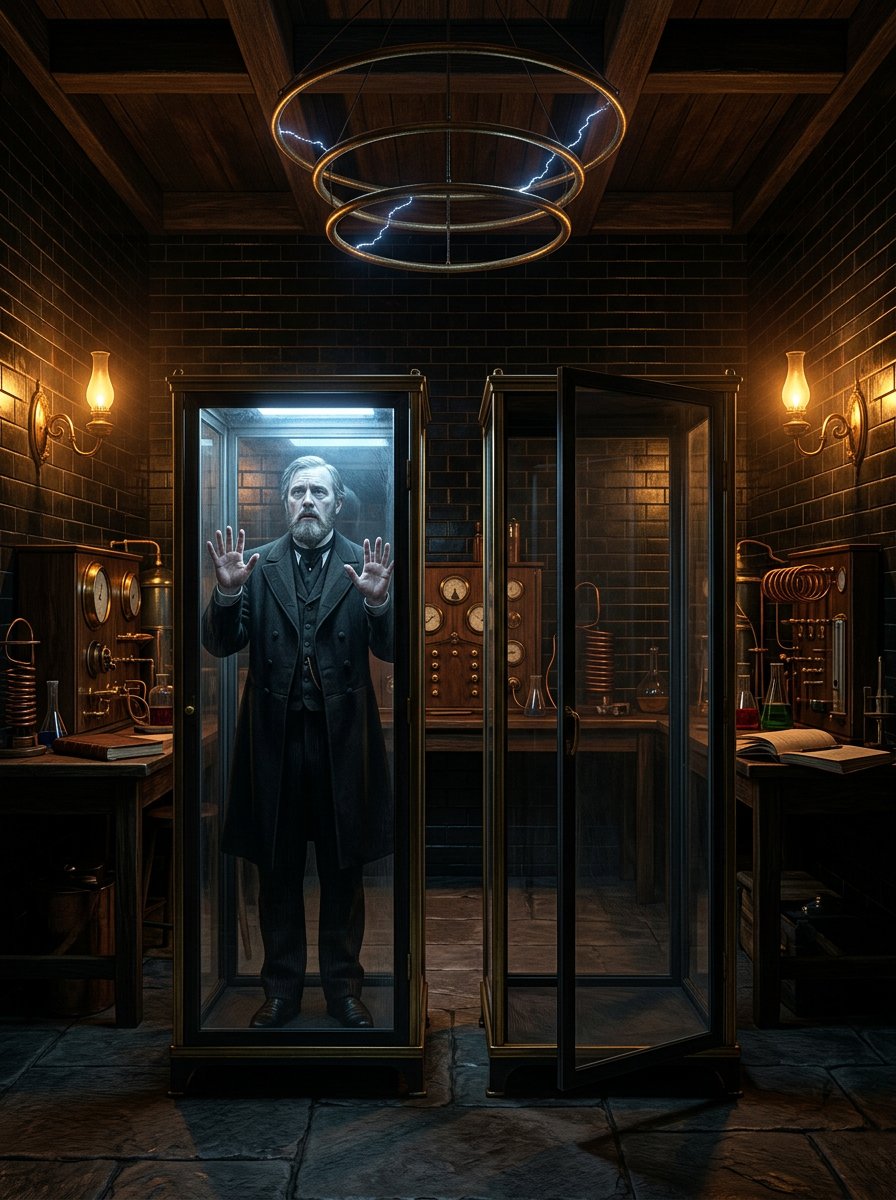
Gaslamps burned along the tiled walls despite the late-morning sun, their mantles hissing softly within glass chimneys. Brass gauges trembled upon walnut panels. Coils of lacquered copper ran along the ceiling like the exposed nerves of some dissected leviathan. Everywhere there were wires, valves, polished rods, and porcelain insulators; everywhere the smell of hot metal, ozone, machine oil, and fear.
At the centre of the room stood the two cabinets.
They were identical in height and shape, each large enough to admit a gentleman standing upright with his hat removed. Their frames were of brass and black iron, their walls composed of thick panes of smoked glass. Each was capped by a crown of rotating rings, concentric and delicate, which from a distance gave the appearance of mechanical halos.
On a plaque fixed to the nearer cabinet, engraved in fine lettering, were the words:
TRANSLATION CHAMBER A
On the other:
TRANSLATION CHAMBER B
Dr. Elias Venn regarded them with the expression of a father looking upon two difficult children whom he had nevertheless resolved to love.
“You are quite certain,” said Mr. Halberd, for perhaps the seventh time that morning, “that the destination chamber has been fully purged?”
Venn did not look away from the cabinets.
“I am certain.”
“And that the pattern-lattice retained integrity through the dog trial?”
“Through the dog trial, the rabbit trial, the copper sphere trial, the orchid trial, and your own pocket watch, which I remind you was returned to you not merely ticking but set to the correct time.”
“My pocket watch,” said Halberd, “did not possess a soul.”
“No,” Venn replied. “Though it may have possessed more courage than its owner.”
A few of the junior men laughed uneasily. No one laughed loudly in the Translation Room. Sound seemed too physical a thing there, too easily caught and dismantled by the great apparatus looming over them.
Professor Adeline Marr stood near the control dais, her gloved hands folded behind her back. Of all the members of the Royal Society of Applied Mechanicks who had supported Venn’s work, she alone had never flattered him. This was why he trusted her.
“Elias,” she said quietly, “there is still time to use another subject.”
He turned then.
“Another subject?”
“A condemned man. A volunteer from the infirmary. Someone whose name will not be printed on the prospectus.”
“My dear Adeline, the whole object of this day is to prove that a man may pass from one place to another without loss. Not a criminal. Not a pauper. Not some poor unfortunate bought for five guineas and a burial. A man. One of us.”
“That is sentiment, not science.”
“It is presentation,” said Venn. “The Board is composed almost entirely of sentiment dressed in waistcoats. If I step into Chamber A and step out of Chamber B, they will fund a line from London to Calais within the year. If some nameless wretch does it, they will demand ten years of animal trials and an archbishop.”
Marr’s mouth tightened.
“And if you do not step out?”
Venn smiled.
“Then you may have my notes.”
She did not smile back.
Beyond the high windows, London laboured beneath its customary veil of soot and industry. Carriages rattled over wet cobbles. Somewhere a factory whistle screamed noon into the fog. The city was all distance and delay: letters carried by hand, bodies carried by horse, goods by rail, news by wire. Venn had spent twenty years regarding distance not as a fact of nature, but as an insult.
The Translation Engine was his answer.
The Board of Imperial Conveyance would arrive at three. There would be speeches. There would be champagne. There would be questions about military application, colonial administration, mail contracts, and whether livestock could be transported without complaint from the livestock. There would be money.
But first there would be Elias Venn.
At half past twelve, the final checks began.
“Capacitors charged,” called Finch, the youngest assistant, his voice cracking.
“Leyden banks stable,” said another.
“Pattern drum at rest.”
“Receiving chamber pressure normal.”
“Galvanic field aligned.”
Halberd wiped his spectacles on a handkerchief already damp with perspiration.
Marr came to him last.
“Elias.”
“Yes?”
“If anything feels wrong, signal at once.”
He smiled through the glass as the chamber door swung open.
“My dear Adeline, if anything feels wrong, I shall already be elsewhere.”
He stepped inside.
The door sealed with a pneumatic sigh.
The world beyond the smoked glass dimmed. He could see figures moving: Marr at the control dais, Halberd near the emergency lever, Finch bent over the signal lamps. Their outlines wavered, warped by the curved panes.
Inside the chamber was a brass handrail, a footplate, and above his head the first of the scanning rings. It smelled faintly of singed dust.
A speaking tube crackled.
“Are you comfortable?” Marr’s voice asked.
“As comfortable as one can be in a coffin designed by electricians.”
“Heart rate?”
“Elevated by boredom.”
“Begin primary induction,” she said.
A vibration rose through the soles of his boots. Not a sound, precisely, but a pressure. The brass walls seemed to inhale. Needles of blue-white light pricked into being along the rings above him.
Venn steadied himself against the rail.
He had expected pain, despite his public assurances. Or not pain, perhaps, but some sensation adequate to the enormity of what was being done: a tearing, an expansion, the soul catching like cloth on a nail.
Instead, there was music.
No one else would have called it that. The rings spun faster, the current climbed, and the chamber filled with a chord so fine and high it seemed less heard than remembered. Venn had a sudden image of his mother’s parlour in winter, of frost on the inside of the window, of a hymn sung by voices in another room.
Then the light intensified.
His hand on the rail became transparent.
He saw, with perfect calm, the bones within his fingers.
Then the spaces within the bones.
Then—
He blinked.
The door of Chamber B opened.
For half a second Elias Venn did not move.
The laboratory stood before him exactly as it had, and yet impossibly altered by angle. He saw Chamber A across the room, the control dais to his left instead of his right, Halberd’s astonished face turned toward him, Finch with both hands over his mouth.
Then sound returned all at once.
A cheer broke from someone. Another voice shouted, “He is through!” A glass instrument shattered on the floor. Finch began to laugh and sob simultaneously.
Venn stepped out of Chamber B.
His knees nearly failed him.
Marr was the first to reach him.
“Elias.” She seized his wrist, not affectionately but diagnostically. “Look at me.”
“I am looking.”
“Your name?”
“Elias Gabriel Venn.”
“Age?”
“Forty-seven.”
“What did you have for breakfast?”
“Tea, toast, and two eggs badly poached by Mrs. Bell, whom I intend to dismiss once I have abolished distance.”
A laugh moved around the room like a spark catching dry paper.
Marr closed her eyes briefly.
“Pulse rapid but strong,” she said.
Halberd approached, pale and shining with sweat.
“You are whole?”
Venn flexed his hands. He touched his face, his beard, the watch chain at his waist. He laughed once, sharply.
“I am whole.”
The room erupted.
Men clapped one another on the back. Finch ran to the signal board and shouted readings to no one in particular. Someone cried, “The Board will have no choice!” Someone else said, “A miracle!” and Halberd, with more theology than scientific discipline, repeated the word.
A miracle.
Venn turned toward Chamber A, expecting to see it empty.
It was not.
At first he mistook the figure within for a reflection.
The smoked glass, the glare of the lamps, the confusion of moving bodies—his mind offered him a dozen explanations in the space of a heartbeat. A trick of angle. A delay in the dissipation field. An afterimage burned upon the pane.
Then the figure inside Chamber A lifted its hand.
Elias Venn lifted no hand.
The laboratory’s celebration died so completely that the ticking of Venn’s watch became audible.
Behind the glass of Chamber A stood Elias Venn.
Not a ruin. Not a ghost. Not some half-made remainder of flesh and steam. He stood upright, one hand pressed against the inside of the door, his face pale but living, his eyes wide with the same dawning horror that Venn felt opening within himself.
Across the room, the two men stared into one another’s eyes.
Or rather, each stared into his own.
Finch whispered, “Oh God.”
The Venn in Chamber A moved first. His mouth formed words, but the seal held them. He struck the glass with the flat of his palm.
Once.
Twice.
The sound was dull and human.
Marr turned on Finch. “Why was the origin not dispersed?”
Finch was frozen.
“Mr. Finch!”
He lurched toward the console. “The confirmation lamp lit! It lit, Professor, I swear it!”
Halberd stumbled to the origin controls. “The vapour circuit—”
“Do not touch that,” Marr snapped.
Everyone stopped.
Venn—outside, in the laboratory, in Chamber B’s shadow—felt the first clear thought form in him since his arrival.
He had always described the Engine to audiences with a kind of elegant simplicity: a body was not its atoms but their arrangement; not the bricks but the house; not the ink but the poem. To translate a man, one had only to read the poem exactly in one place and print it exactly in another. The origin matter, once the receiving pattern was confirmed, was to be dispersed — converted to radiant vapour. Not loss, he had always said. Continuation.
He looked at the man behind the glass.
“I am the copy.”
No one answered.
The man in Chamber A struck the glass again.
Venn looked at his hand. It trembled. He closed it into a fist.
“I am the copy,” he repeated.
Marr came toward him, but he stepped back.
“Elias—”
“No. No, that is not accurate.” His voice was thin, rapid. “The term is prejudicial. I am the received instance. The pattern continuity—”
The man in Chamber A shouted soundlessly.
Venn stopped.
There was a smear from his palm on the inner glass.
Marr said, “We do not know what has occurred.”
“Of course we know,” said Halberd. He had gone grey. “The receiving chamber reconstructed before the origin chamber dispersed.”
“Because the vapour circuit failed?” Marr asked.
Finch shook his head, nearly crying. “No. No, the circuit is armed. It is waiting.”
“Waiting for what?”
Finch swallowed. “Manual confirmation.”
All eyes moved to Halberd.
He stared down at the brass lever beside Chamber A.
A red enamel handle. A polished plate beneath it read:
ORIGIN DISASSEMBLY — FINAL
Halberd’s voice was barely audible.
“I thought it prudent.”
Venn turned slowly. “You altered my machine?”
“I added a safeguard.”
“A safeguard?”
“In case the receiving pattern was incomplete. In case something came through wrong. I thought—before dispersing the original—someone ought to be able to verify—”
Venn laughed.
The sound frightened him more than anything else had.
“In case something came through wrong,” he said.
The man in Chamber A had ceased striking the glass. He stood now with both hands pressed to it, watching them. Watching the lever. Watching Halberd.
Marr moved to the speaking tube and opened the valve to Chamber A.
The room filled with a harsh metallic hiss. Then a voice emerged.
“Open the door.”
It was Venn’s voice.
Not similar. Not imitated. His.
“Adeline,” said the man inside Chamber A, “open the door.”
The Venn outside felt every head turn slightly toward him, then away again, as if the room itself had become unsure which direction contained the real man.
Marr stood very still.
“Elias,” she said into the tube, “remain calm.”
“Do not speak to me as if I were a patient. Open the door.”
“We must understand the condition of the apparatus.”
“I understand it perfectly. Halberd has made a coward’s amendment and trapped me in a glass box.”
Halberd flinched.
The Venn outside said, “He cannot be released.”
The words came from him before he had decided to say them.
The man in Chamber A looked at him.
A silence followed.
Then, through the speaking tube:
“I beg your pardon?”
Venn outside swallowed. “If we open the chamber, there will be two of us.”
“There are two of us.”
“That is precisely the difficulty.”
The original—if original was the word, and it was, damn it, it was—leaned closer to the glass.
“Who are you to find difficulty in my existence?”
Venn felt heat rise in his face. “I am Elias Venn.”
“You are a successful print.”
“I am the man who stepped out of Chamber B.”
“And I am the man who stepped into Chamber A.”
“That distinction may not be material.”
“It is material to me.”
Marr said, “Enough.”
But it was not enough. It would never be enough again.
The laboratory had divided itself without instruction. Finch and two assistants stood near Chamber B, glancing nervously at the Venn who was free. Halberd remained by the lever, as if magnetised by his own guilt. Marr stood between the two booths, her face composed but bloodless.
Outside, a bell rang somewhere in the building.
One o’clock.
Two hours until the Board arrived.
The sound seemed to restore Halberd to terror.
“The demonstration,” he said.
Marr turned on him. “Damn the demonstration.”
“The Board will be here at three.”
“Then they can wait.”
“They will not wait. Do you understand what is at stake? Years of funding. The Imperial contract. The patents.”
“There are two living men in this room,” Marr said.
“There must not be,” Halberd replied.
Everyone heard him.
The man in Chamber A smiled, but it was not amusement. Venn knew that smile. He had worn it at funerals, at academic humiliations, at moments when rage had become too refined for shouting.
“Mr. Halberd,” said the original, “if your hand approaches that lever, I will spend whatever remains of my life ensuring history knows you as a butcher.”
Halberd whispered, “Which life?”
The words struck the room like a thrown stone.
The Venn outside stepped toward Chamber A.
“Listen to me.”
“I have no interest in listening to an echo.”
“You are frightened.”
“I am imprisoned.”
“You know what the machine requires.”
“I know what the machine was built to conceal.”
“It was not concealment. It was necessity. The origin matter must be dispersed to prevent duplication.”
“To prevent embarrassment.”
“To prevent paradox.”
“To prevent there being two claimants to one life.”
The original’s eyes sharpened.
“One life,” he said. “Exactly.”
Venn outside felt the floor tilt beneath that phrase.
One life.
His rooms in Gower Street. His books, his debts, his unfinished letter to the Patent Office. His memory of his father’s hands smelling of tobacco. His dislike of pears. His scar beneath the left shoulder from a childhood fall through greenhouse glass. His affection for Adeline Marr, unspoken for eighteen years and therefore immense.
All his.
And all the other man’s.
If the original stepped out, what became of him?
Not legally. Law was a clumsy animal; it would eventually decide something grotesque. But beneath that—what was he?
He possessed every memory up to the instant of light. He remembered entering Chamber A. He remembered being ready to die, though he had not called it dying. Then he remembered emerging from Chamber B. Was that not continuity? Was he not the man who had undertaken the risk and survived it?
But across the room stood the man who had never ceased.
The man who had not been interrupted.
The man with the senior claim.
Marr seemed to see the thought pass through him.
“Elias,” she said softly.
Both men answered.
“Yes?”
The horror of that small chorus silenced even the machines.
Marr closed her eyes.
The original laughed once from inside the booth.
“There is your miracle.”
Finch began mumbling at the console. “There may be another way. We could reverse—no, no, not reverse. Suspend the origin. Maintain containment until—”
“Until when?” asked Halberd.
“Until we consult the Society.”
“And tell them what? That Venn’s transporter is in fact a duplicator and that its first human subject is arguing with himself about who deserves to live?”
“The Board cannot see this,” said Halberd.
Marr’s voice was ice. “You are very concerned with what the Board sees.”
“I am concerned,” Halberd said, gathering force from desperation, “with whether this invention survives the afternoon. Do none of you understand? If this becomes scandal, it is finished. Worse than finished. It becomes criminal. Parliament will prohibit it before supper. The Church will preach against it by Sunday. Every newspaper in London will print cartoons of duplicated husbands and immortal murderers. We shall lose not merely the contract but the century.”
“And your solution?” Marr asked.
Halberd did not look at Chamber A.
“The machine’s intended cycle must be completed.”
The original whispered, “Coward.”
But the Venn outside was silent.
Complete the cycle.
That was the phrase, wasn’t it? Not murder. Not execution. Completion. The apparatus had not finished. The man in Chamber A was not a person, in that formulation, but an unremoved scaffold, a candle left burning after dawn.
He felt sick.
Because some part of him—a cold, functional, elegant part—agreed.
If the lever were pulled, there would be one Elias Venn. The demonstration could proceed, altered perhaps, delayed perhaps, but intact. He would go before the Board shaken but triumphant. No one need know. Halberd’s manual safeguard would be removed. In future, the origin would disperse instantly, mercifully, invisibly, before any eyes could open in the old chamber and plead for metaphysics.
The world would change.
All it required was that the man in Chamber A die.
The man who had stepped into the machine.
The man he had been until seven minutes ago.
The original looked at him.
“You are considering it.”
Venn outside said nothing.
“You are,” said the original. “I can see it. I know that look. That is the look we wore when we decided not to publish Calder’s objection because he had made an arithmetical error in the third appendix and we could therefore ignore the moral thrust of the whole paper.”
Venn flushed.
The original pressed closer.
“You think because you stand outside the glass that you have inherited the future. But I am not your husk. I am not your discarded envelope. I am standing here, Elias. I am afraid. I am angry. I am thinking. Are those not the qualifications?”
Venn’s voice broke. “For what?”
“For being you.”
Marr moved to the door mechanism of Chamber A.
Halberd seized her arm.
“No.”
She struck him.
The crack of it rang through the laboratory.
Halberd staggered back, more astonished than hurt.
Marr placed her hand on the wheel.
The original’s face changed. Hope, naked and terrible, appeared upon it.
The Venn outside shouted, “Wait.”
Marr froze.
He heard himself breathing. He hated every breath.
“If you open that door,” he said, “there is no undoing it.”
Marr turned to him. “If I do not open it, there is no undoing that either.”
“He is me.”
“Yes.”
“And I am me.”
“Yes.”
“Then which of us do you intend to save?”
Her answer came only after a pause.
“The one I can save first.”
The original closed his eyes.
Venn outside looked at the red lever.
He imagined pulling it himself. The hiss of radiant vapour. The glass whitening. The removal of contradiction. Would it hurt? The animals had shown no signs. But then, they had not understood the lever.
He imagined the original stepping out. Two men with one name. Two signatures. Two claims upon the same past, the same work, the same quiet griefs. One would have to vanish socially if not physically. One would be called false. One would become evidence.
Which one?
The clock on the wall ticked.
At three o’clock the Board would arrive expecting conquest over distance. Instead they would find distance had opened within a single human soul.
The original spoke again, quieter now.
“Elias.”
The Venn outside looked up.
“I know what you fear,” said the man in the booth. “I fear it too.”
“Yes.”
“You fear that if I live, you become secondary.”
Venn said nothing.
“But if I die,” the original continued, “what do you become then?”
The question entered him with surgical precision.
If the lever were pulled, he would go on. He would eat, sleep, lecture, age. He would be embraced as the survivor of the first human translation. By all outward measures he would be Elias Venn.
But somewhere, always, there would be the memory of a man behind glass asking to be let out.
Not a stranger.
Not even a twin.
Himself.
And if he could consent to that death because it was convenient—because it preserved the invention, the funding, the applause—then what exactly had been transported into Chamber B? A man? Or merely ambition, arranged in the shape of one?
He turned to Halberd.
“The Board must not see the apparatus today.”
Halberd’s face collapsed. “Elias—”
“Which one?” Venn asked.
Halberd had no answer.
Venn almost smiled.
“Precisely.”
He walked to the control dais. Every step felt borrowed. He took the demonstration schedule, the prepared remarks, the certificate of technical readiness bearing his signature. He tore them once, twice, again, until the pieces scattered across the floor like dirty snow.
Then he went to Marr.
“Open it.”
She searched his face.
“Are you certain?”
“No.”
That seemed to satisfy her more than certainty would have.
She turned the wheel.
Steam sighed from the chamber seal. The bolts withdrew one by one with heavy metallic clacks. The door of Chamber A opened outward.
For a moment, the original did not move. Perhaps he feared some final trick, some hidden field that would disperse him the instant he crossed the threshold.
Then he stepped out.
The two men stood facing each other with no glass between them.
Up close, the differences began at once. The original’s hair was damp with sweat from the sealed chamber. A red mark showed on his palm where he had struck the glass. His collar sat slightly crooked. The received Venn—no, the other Venn, he thought; language must be made humble—stood with his coat dusted by ash from Chamber B’s door.
Seven minutes of divergence, and already the universe had begun its work.
The original extended his hand.
The copy looked at it.
Then took it.
The handshake was the most obscene intimacy either had ever known.
Halberd sank into a chair.
“What shall we tell them?” he whispered.
Marr removed her gloves.
“The truth.”
Halberd laughed weakly. “There is no funding in truth.”
“No,” said one Venn.
“But there may be science,” said the other.
They looked at each other, startled by the division of the sentence.
Then, despite everything, both almost laughed.
At five minutes to three, the Board of Imperial Conveyance arrived in silk hats and expectation.
They were not admitted to the Translation Room.
Instead they were received in the lecture hall, where Professor Marr informed them that the demonstration had been postponed on account of an unforeseen philosophical complication.
The phrase did not please them.
Sir Aubrey Kest, chairman of the Board, demanded to see Dr. Venn.
There was a brief consultation in the corridor.
Then both Dr. Venns entered.
History, which is fond of clean beginnings, would later struggle with that afternoon. Some accounts claimed the Board fled immediately. Others insisted Sir Aubrey fainted, though in truth he merely sat down very quickly and called for brandy. The newspapers, when at last the story escaped—as all imprisoned things eventually do—named it the Venn Duplication, the Gower Street Heresy, the Twofold Man, and, with the vulgar brilliance of the press, The Gentleman Who Arrived Before He Left.
The Translation Engine was not funded.
Parliament did not prohibit it before supper, but only because Parliament was not in session. The Church managed Sunday with admirable punctuality. Halberd resigned from the Society and later published a pamphlet defending the necessity of automatic origin dispersal, which sold poorly until banned, after which it sold very well.
As for Elias Venn, the matter proved more difficult.
The law, finding no precedent and little appetite, eventually declared the original Elias Venn legally continuous and the received Elias Venn a “separate natural person possessing derivative identity,” a phrase that satisfied no one except the barrister paid to invent it.
The original remained in London for a time. He defended the work, then denounced it, then defended it again in private correspondence. He grew quieter. He developed a habit of standing in doorways before entering rooms, as though uncertain what might be lost in crossing.
The received Venn took the name Gabriel, his unused middle name, and left England within the year. He lectured in Prague, Vienna, and Boston on pattern theory and the ethics of continuation. Audiences came less to understand the mathematics than to watch him drink water, adjust his cuffs, answer questions, and thereby prove that impossibility could perspire.
Neither man married.
They wrote to each other at first with the feverish precision of rival scientists disputing priority. Then, gradually, as their memories diverged and their grievances lost symmetry, the letters softened into something stranger than brotherhood and less comfortable than friendship.
Years later, when the original Elias Venn was dying of pneumonia in his rooms in Gower Street, a cable was sent across the Atlantic.
Gabriel Venn arrived too late, by ordinary ship and rail, distance having reasserted its old tyranny.
On the desk he found a letter addressed to him in his own hand.
It contained only three lines.
I have wondered all my life whether you were the ghost, or I was.
I no longer think that was the question.
Forgive me for making you alone.
Gabriel read it once standing, once seated, and once with his face in his hands.
Then he took from his coat pocket the watch that had come through with him in Chamber B. It had never kept proper time afterward. It gained three minutes each day, as if some part of it remained eager to arrive.
He placed it beside the dead man’s watch on the desk.
For a while, the two ticks filled the room, nearly together, never quite one.
And outside, in the fog and iron murmur of the city, men continued to cross distances slowly, mercifully, one body at a time.