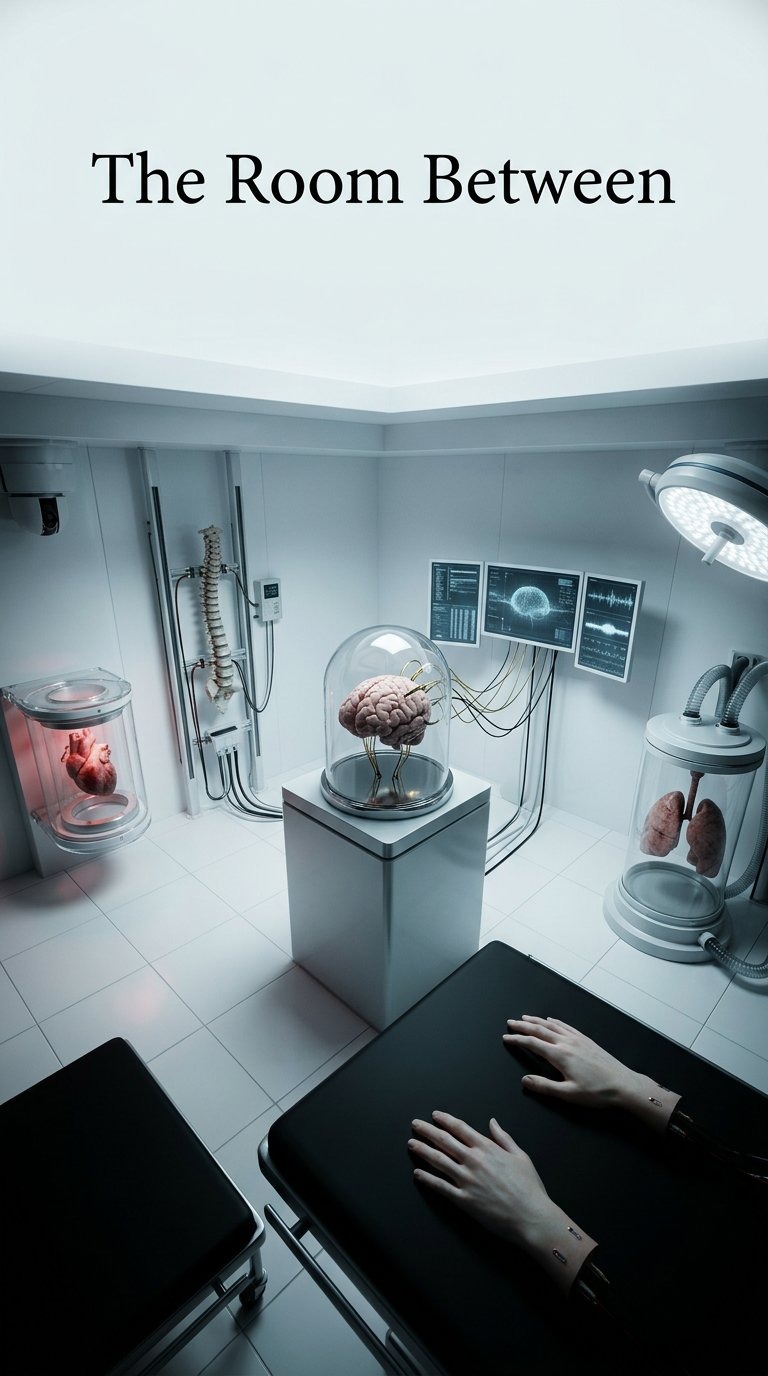
The Room Between
By The Founder on Apr 30, 2026
AI model/tool: GPT-5.5
When Elias woke, he couldn’t open his eyes.
That was the first impossible thing.
There was no familiar darkness behind lids, no slow brightening as the body returned to itself. Sight simply existed. It arrived all at once: a white room, a surgical table, black seams in the walls, soft panels of ceiling light, glass cylinders, steel arms, cables hanging like vines.
He tried to blink.
Nothing happened.
He tried to turn his head.
The room did not move.
Only then did he understand that he was not seeing from a face.
His vision was fixed at one side of the room, low and slightly angled, as though his gaze had been mounted there. He could not feel eyelids. He could not feel cheeks, brow, nose, skull. There was only vision: two wet windows held open somewhere behind him, or around him, or in a place that no longer had a name.
Across the room, under a clear dome, lay what looked very much like a brain.
At first Elias refused to know what it was. The object was too intimate to be recognized. It glistened softly in nutrient mist, pale and folded, threaded with hair-thin filaments of gold and black. A cluster of cables ran from its base into a bank of machines whose lights pulsed in delicate patterns.
Then a thought occurred to him.
That is my brain.
The machines brightened.
The thought that identified the brain had been made by the brain he was looking at.
A pressure like terror rose in him, but there was no chest to contain it.
He tried to breathe. No lungs answered. He tried to swallow. No throat closed. He tried to call out, and for a while there was only silence.
The white room remained steady in his sight.
Around the brain were other pieces of him, arranged with careful spacing, as if the body had become a diagram.
His hands rested palms-down on a black table in the far corner. Sensors entered the wrists in bright bundles. The fingers were slightly curled. On the left thumb was the old crescent scar from when he was seven and had tried to cut an apple with a knife too large for his hand.
He recognized the scar, and memory opened around it: the kitchen tile, the red towel, his mother’s voice going thin with fear.
One finger twitched.
A sensation reached him.
Cold.
Not cold in the room. Cold in the fingertip. The surface beneath the hand was smooth, hard, faintly vibrating with the machinery around it.
Elias tried to pull away. The hand in the corner dragged backward half an inch.
He felt the motion from across the room.
Somewhere to the left of his fixed vision, unseen but unmistakable, his eyes must have been anchored in a cradle, connected by their stems and nerves to whatever system still called itself him. They received the room. The brain across the room interpreted it. The hands in the corner touched it. And between all these stations, something suffered continuity.
He saw his heart next.
It beat inside a magnetic suspension frame, dark red and muscular, contracting with obscene patience. Beside it, lungs expanded and collapsed in a glass cylinder. Not breathing, exactly. Being breathed. Air entered them because a machine insisted upon rhythm.
There were ears in a shallow bath. A tongue. A section of spine held along a rail like a pale cable.
Elias understood each part only after looking at it, and each act of recognition made the brain flicker under its dome.
He could see the place where seeing became thought.
He could watch the organ that was watching.
No, he thought.
The monitors around the brain sparked.
No.
The denial did not change the room.
His mind tried to retreat to the old location, the private chamber behind the eyes where he had always assumed he lived. But there was no chamber now. His eyes were fixed somewhere off to the side, looking outward. His brain lay exposed in front of them. His hands waited in a corner, feeling what they were told to feel. His body had become a room.
And yet there was still an “I.”
That was the worst of it.
The experiment had not killed him. It had made him difficult to point to.
A door opened outside his field of vision. Footsteps entered, soft against the floor.
A woman crossed into view wearing a white pressure suit with a transparent hood. Dr. Vale. He remembered her name before he remembered why.
“Elias,” she said. “You’re awake.”
The brain flickered.
“What did you do?” he tried to ask.
A speaker above the room crackled. His voice emerged from it, thin and artificial.
“What did you do?”
Dr. Vale exhaled. Her breath fogged the inside of her hood for an instant.
“You survived the separation,” she said. “The integration is holding.”
Separation.
The word was too small.
“You took me apart.”
“We preserved continuity.”
He would have laughed if laughter had still belonged to him. Instead the speaker produced a brief, dry burst of static.
Dr. Vale glanced toward the place from which he was seeing. He could not turn to follow her gaze. He could only watch her face as she looked at his eyes, somewhere outside his own view.
Then she looked back toward the brain under glass.
“We need to ask you some questions,” she said. “Can you describe your subjective position?”
The phrase passed through him like cold metal.
“My what?”
“Where do you feel that you are?”
Elias stared at the brain.
The brain, in turn, processed the image of itself. The absurd loop closed and closed and closed.
Where was he?
Not in the eyes. The eyes were simply the source of the image, fixed behind the frame of his vision, absent to themselves. He could not see them, but he knew they were there because the world kept arriving.
Not in the hands. The hands could touch, but they waited at a distance like trained animals.
Not simply in the brain, though thought burned there. If he was only the brain, why did seeing from elsewhere feel like here? Why did the cold table under his fingertips come home to him from a corner of the room? Why did the heart in its frame still frighten him by continuing?
He searched for a center and found only relations.
Light became signal. Signal became image. Image became recognition. Recognition became fear. Fear became a question. The question returned through a speaker and entered the room as sound.
Maybe the self was not a point.
Maybe it had never been a point.
Maybe the body had only fooled him by keeping all its distances small.
And the soul?
The word rose from some old, rejected part of him. Soul. He had not used it seriously in years. He had believed in neurons and chemistry, in memory as storage, love as endocrine weather, consciousness as a property of sufficient complexity.
But now he was looking at the complexity.
It lay across the room in a glass dome, wet and threaded with wires.
Still, something exceeded the diagram. Not something supernatural, perhaps. Not a ghost hidden in the meat. But a tension. A shape made by all the signals still reaching for one another. A longing for unity that persisted after unity had been surgically disproved.
Maybe the soul was not where the body was.
Maybe the soul was the ache of the body trying to mean one thing.
Dr. Vale stepped closer to the brain.
“Elias,” she said gently, “where are you?”
His right hand, far across the room, curled against the black table. He felt the fingers close. His heart beat in its frame. The lungs rose and fell under glass. His brain shimmered with captured lightning.
The speaker clicked.
“I’m not in one place,” Elias said.
Dr. Vale became very still.
“I’m in the distance between them.”
For the first time, the room seemed larger than it had before. Not empty. Not sterile. Full of him. Full of impossible roads along which sensation traveled, full of crossings and returns, full of a scattered body insisting on a single name.
He looked at his brain until the sight of it became unbearable.
Then, with the hands he could see but could not be near, he touched the table again, just to feel something answer.
“I think,” Elias said, “my soul is the part that still says all of this is mine.”
Comments
Log in to comment or rate.